

Rehasense PAWS Tourer vs Triride T-Rocks: Which Is Better Off-Road?
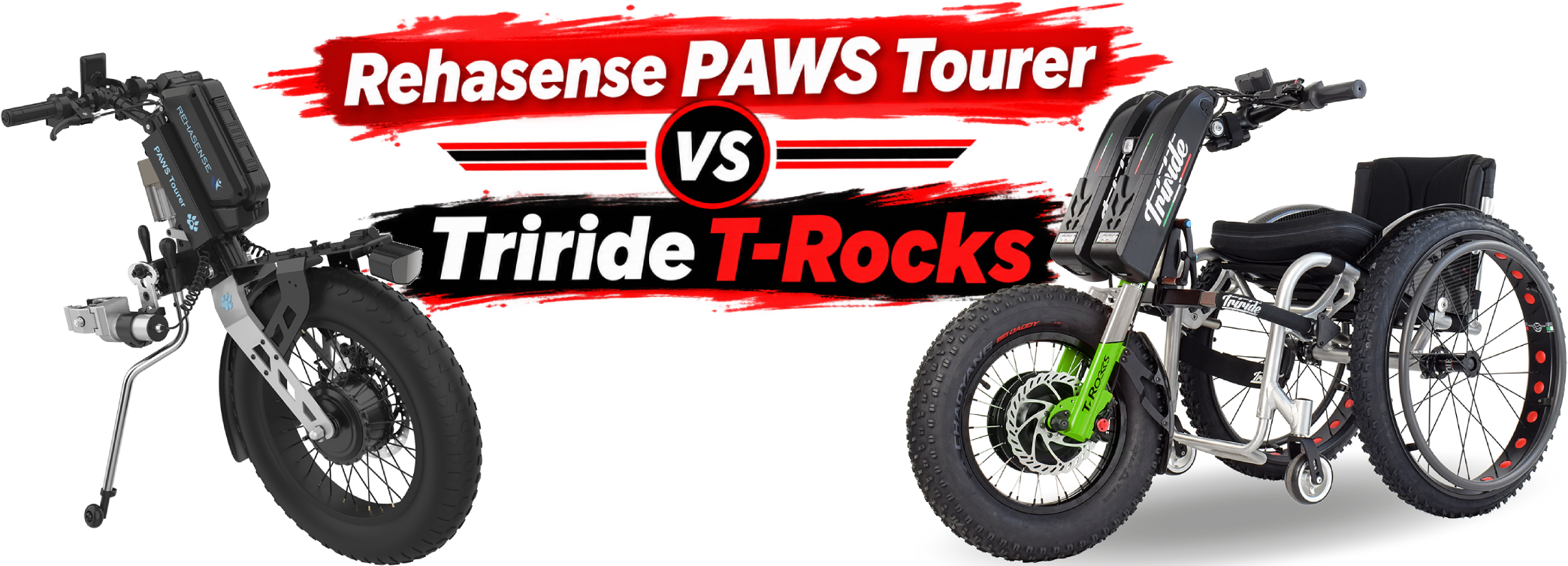
PAWS Tourer vs Triride T-Rocks
The Rehasense PAWS Tourer and Triride T-Rocks are two power attachments designed for wheelchair users who want to explore beyond smooth pavements. However, they approach off-road mobility differently.
The PAWS Tourer uses a large 20-inch front drive wheel, available with either a standard 2-inch tyre or a wider 4-inch fat tyre. The Triride T-Rocks takes a different approach, combining a 16-inch cross tyre with a 65 Nm high-torque motor.
Both offer features intended for outdoor use. However, the right choice depends on the surfaces you regularly encounter, how you transport your equipment and which handling characteristics you prefer.
This comparison examines their published specifications and practical differences to help you make a more informed decision.
Want to Try These Products for Yourself?
See how these wheelchair power attachments work for you. Visit our next Roadshow or arrange a personal demonstration.
Try These Products at Our Next Roadshow
Meet the team, explore the products and try them in person at our next Wheelchair Roadshow UK event.
Next Roadshow: 10 April (date to be confirmed)
Register for the Roadshow →Prefer to Try One Now?
Arrange a free home, showroom or online demonstration with Invictus Active at a time that suits you.
No need to wait for the next Roadshow.
Book Your Free Demo →Rehasense PAWS Tourer vs Triride T-Rocks: Quick Comparison
The following table compares the published manufacturer specifications.
Where specifications depend on the configuration, this is explained rather than assuming both products have identical setups.
| Feature | Rehasense PAWS Tourer | Triride T-Rocks |
|---|---|---|
| Main purpose | Off-road and outdoor touring | All-terrain and off-road use |
| Drive wheel | 20 inches | 16 inches |
| Tyre options | 20 x 2 inches or 20 x 4 inches | 16-inch cross tyre, 4-inch version |
| Motor power | 500 W | 1,500 W HT motor, as advertised by Triride |
| Maximum torque | 87 Nm | 65 Nm |
| Battery voltage | 48 V | 48 V |
| Standard battery capacity | 557 Wh | 504 Wh (48 V, 10.5 Ah configuration) |
| Published maximum range | Up to 35 km | Up to 50 km |
| Total weight | Approximately 27.5 kg (2-inch tyre); 28.8 kg (fat tyre) | From 12.8 kg, excluding battery and wheelchair connection arms |
| Maximum user weight | 120 kg | Confirm current configuration with supplier |
| Climbing capability | 10% stated by Rehasense | No comparable maximum figure verified |
| Braking | Hand-operated braking system | Disc brake and electronic regenerative braking |
| Drive modes | Multiple assistance settings | Normal, Sport and Eco Drive |
| Reverse | Available | Available |
| Special features | Automatic/manual clamping and lifting, track assistance and Tetra controls | IBS and ICC safety package, cruise control and assisted loading |
1. Rehasense PAWS Tourer: Designed for Outdoor Exploration
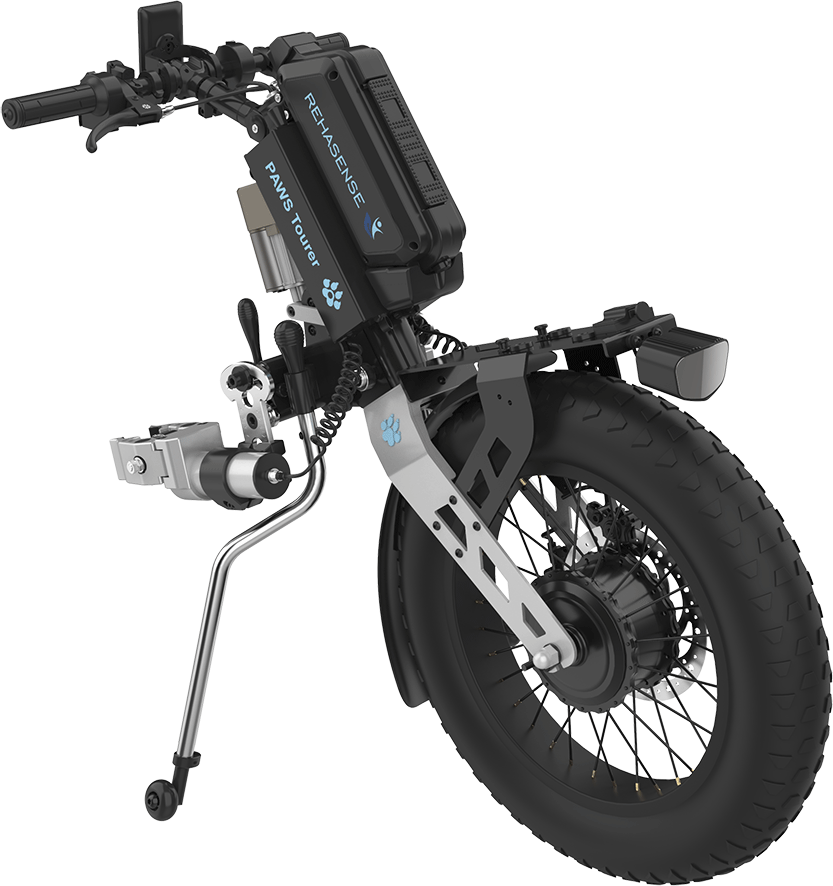
The Rehasense PAWS Tourer is the largest model in the PAWS power attachment range.
It has been developed for wheelchair users who want to travel across more demanding outdoor surfaces.
Its long wheelbase and large front drive wheel distinguish it from the smaller PAWS City and Cruiser models.
The Tourer is available in two main tyre configurations:
20 x 2-inch tyre: A narrower, all-purpose configuration.
20 x 4-inch fat tyre: A wider option designed for more challenging surfaces.
This distinction is important. A Tourer fitted with the wider fat tyre is not the same setup as one supplied with the standard tyre.
What makes the PAWS Tourer suitable for off-road use?
The wider fat tyre provides another option for users who regularly encounter softer or rougher ground. However, actual traction will depend on tyre pressure, surface conditions, user weight and wheelchair setup.
The longer wheelbase is another important consideration. It contributes to the Tourer’s overall riding characteristics, although the larger assembly also requires more space.
PAWS Tourer technical specifications
| Specification | 20 x 2-inch | 20 x 4-inch Fat Tyre |
|---|---|---|
| Drive wheel | 20 inches | 20 inches |
| Total weight | Approx. 27.5 kg | Approx. 28.8 kg |
| Weight without battery | Approx. 24.2 kg | Approx. 25.5 kg |
| Motor power | 500 W | 500 W |
| Maximum torque | 87 Nm | 87 Nm |
| Battery | 48 V, 11.6 Ah | 48 V, 11.6 Ah |
| Battery capacity | 557 Wh | 557 Wh |
| Maximum stated range | 35 km | 35 km |
| Maximum user weight | 120 kg | 120 kg |
| Stated climbing capability | 10% | 10% |
| Turning radius | 150 cm | 150 cm |
PAWS Tourer: Clamping and control options
Depending on the selected configuration, the Tourer can have:
⇒ Manual clamping and manual lifting.
⇒ Automatic clamping and automatic lifting.
⇒ Standard handle controls.
⇒ Tetra controls for users with particular hand-function requirements.
The automatic system is designed to make docking and undocking easier. However, the exact configuration should be selected during the assessment and ordering process.
PAWS also offers track assistance, which helps the attachment return towards a straight position after steering.
This can be useful when travelling along longer paths. It is worth testing because steering feel is a personal preference.
Potential advantages of the PAWS Tourer
⇒ Choice of standard and fat-tyre configurations.
⇒ Published 87 Nm maximum torque.
⇒ Automatic or manual docking options.
⇒ Tetra control options.
⇒ Manufacturer-published 120 kg maximum user weight.
Important considerations
⇒ Its 150 cm turning radius requires consideration in confined spaces.
⇒ The larger assembly may require additional planning for vehicle transport.
⇒ The manufacturer’s user manual includes important restrictions concerning surface conditions and safe operation.
2. Triride T-Rocks: A High-Torque Off-Road Power Attachment
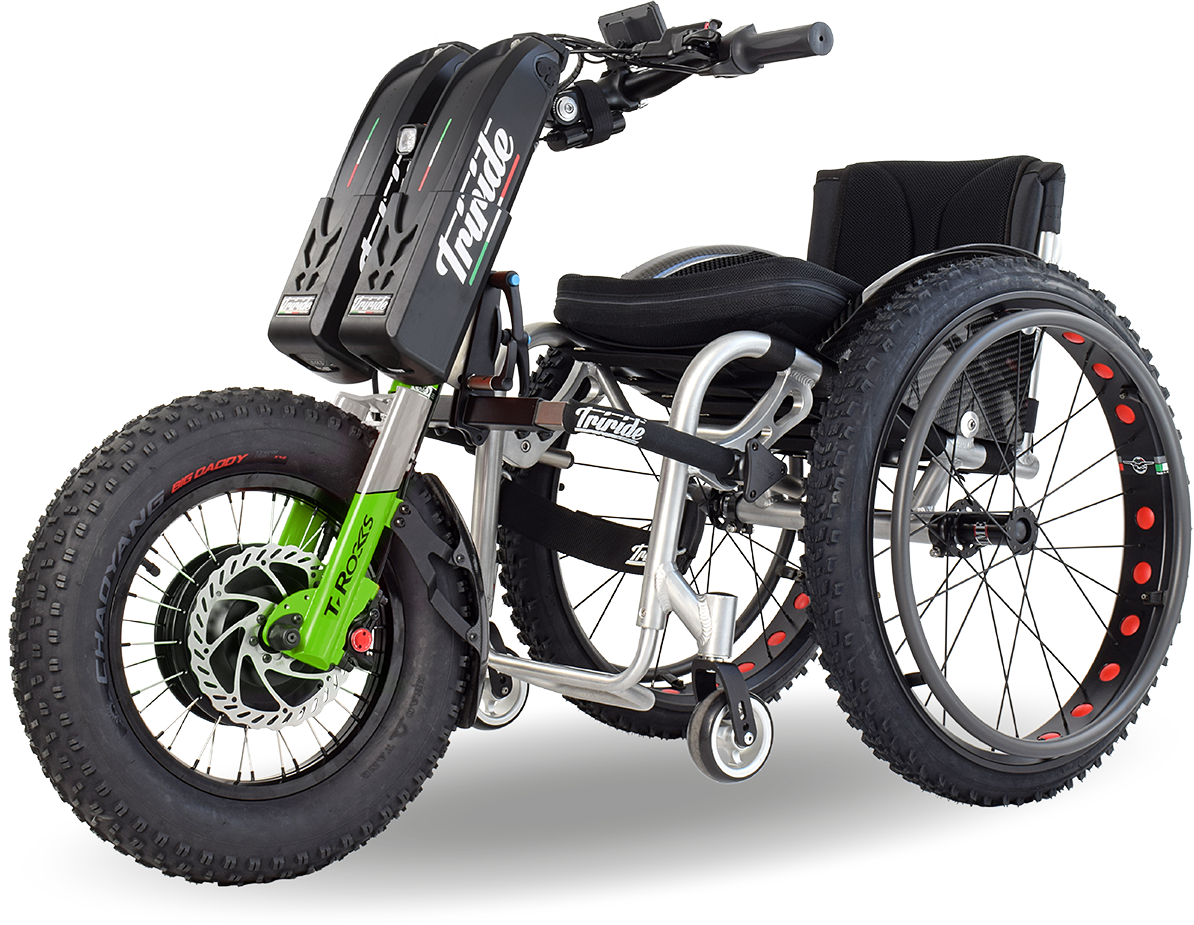
The Triride T-Rocks is designed specifically for wheelchair users who want an attachment suited to outdoor adventures and more demanding terrain.
Unlike the PAWS Tourer’s 20-inch wheel, the T-Rocks uses a 16-inch cross tyre. Its high-torque motor and off-road-oriented tyre design are central to its specification.
Triride also offers a range of electronic controls designed to give users greater control over the driving experience.
What makes the T-Rocks different?
Triride advertises a 1,500 W motor for this model. However, motor wattage and torque describe different characteristics, so the two figures should not be treated as direct measures of comparative performance.
Its 16-inch cross tyre is designed with outdoor traction in mind. The manufacturer also describes the updated model as having a redesigned fork intended to improve performance.
The T-Rocks is available with a single or optional double lithium-ion battery, depending on the selected configuration.
Triride T-Rocks technical specifications
| Specification | Published Information |
|---|---|
| Drive wheel | 16 inches |
| Tyre | Cross, 16 x 4-inch configuration |
| Motor | HT High Torque |
| Advertised motor power | 1,500 W |
| Maximum torque | 65 Nm |
| Battery voltage | 48 V |
| Standard battery configuration in technical sheet | 10.5 Ah |
| Battery capacity | 504 Wh |
| Published maximum range | Up to 50 km |
| Transport weight | From 12.8 kg, excluding battery and wheelchair connection arms |
| Battery arrangement | Single or optional double battery |
| Drive profiles | Normal and Sport |
| Energy-saving mode | Eco Drive |
| Braking | Disc and electronic regenerative braking |
| Display | LCD with five selectable power levels |
| Additional features | Reverse, cruise control and assisted loading |
T-Rocks electronic driving features
The T-Rocks includes several features that may be useful when travelling outdoors.
Normal and Sport modes: These provide different driving profiles, allowing users to select a suitable response for their journey.
Eco Drive: An energy-saving mode designed to manage battery consumption.
Regenerative braking: The electronic braking system can recover energy during braking and downhill travel, according to the manufacturer.
Reverse: Provides a reverse function for manoeuvring.
Cruise control: Allows the user to maintain a selected driving speed without continuously operating the throttle.
Five power levels: The LCD display provides selectable assistance levels.
The T-Rocks also includes the IBS and ICC safety package as standard, according to Triride’s technical documentation.
Potential advantages of the T-Rocks
⇒ 65 Nm HT high-torque motor.
⇒ Published range of up to 50 km.
⇒ Optional double-battery arrangement.
⇒ Regenerative braking.
⇒ Five selectable power levels.
⇒ Normal, Sport and Eco Drive profiles.
⇒ Reverse and cruise control.
⇒ Lower quoted device weight before adding the battery and connection arms.
Important considerations
⇒ The complete ready-to-use weight needs confirming with the supplier.
⇒ Double-battery configurations may affect total weight and transport arrangements.
⇒ Maximum user weight and wheelchair compatibility need to be checked for the selected setup.
3. PAWS Tourer vs T-Rocks: Which Has Better Off-Road Performance?
There is no single specification that determines how well a wheelchair power attachment performs on every surface.
Wheel size and tyre design
Larger wheels can help negotiate certain obstacles because their diameter changes the angle at which they approach an uneven surface. However, this does not automatically mean that the larger wheel will offer better traction.
The tyre’s width, tread, pressure and construction also matter.
The PAWS Tourer’s 4-inch fat tyre is particularly relevant for users who regularly encounter softer ground. The T-Rocks takes a different approach with its cross tyre and high-torque drive system.
Practical consideration: If your regular routes include loose gravel, grass, woodland paths or sandy areas, compare the exact tyre configurations rather than just the model names.
Motor power and torque
The published motor figures are:
⇒ PAWS Tourer: 500 W and 87 Nm.
⇒ Triride T-Rocks: 1,500 W advertised HT motor and 65 Nm.
The PAWS Tourer has the higher published torque figure. The T-Rocks has the higher advertised wattage.
However, neither figure alone establishes which attachment will climb a particular hill more effectively.
Performance also depends on gearing, motor characteristics, wheel traction, battery output, rider weight and the wheelchair’s overall setup.
A practical demonstration on a representative incline is more useful than choosing solely from the numbers.
Battery capacity and range
The PAWS Tourer has a published 557 Wh battery, while the T-Rocks technical sheet lists a 48 V, 10.5 Ah battery, equivalent to 504 Wh.
The published maximum ranges are:
⇒ PAWS Tourer: Up to 35 km.
⇒ Triride T-Rocks: Up to 50 km.
These are manufacturer figures, not guaranteed real-world distances.
The T-Rocks has the higher published maximum range despite its lower stated standard battery capacity. This highlights why range cannot be calculated reliably from battery capacity alone.
Driving speed, terrain, gradients, temperature, rider weight and tyre conditions all influence consumption.
The optional double-battery arrangement on the T-Rocks is also worth discussing with the supplier if longer journeys are a priority.
Weight and transportation
The PAWS Tourer weighs approximately 27.5 kg with its standard tyre configuration and 28.8 kg with the fat tyre.
The T-Rocks has a quoted transport weight from 12.8 kg. However, this figure excludes the battery and wheelchair connection arms.
It would therefore be misleading to say that the complete T-Rocks is half the weight of the PAWS Tourer.
Before purchasing either product, ask for the following:
⇒ Complete operating weight.
⇒ Weight with the battery removed.
⇒ Weight of removable components.
⇒ Dimensions when prepared for transport.
⇒ Whether additional transport accessories are available.
This will help establish which attachment is easier to handle in your particular circumstances.
4. Which Is Better for Different Outdoor Surfaces?
The best choice depends on where you intend to use the attachment.
Here is how the two models compare across common outdoor environments.
Gravel paths
The PAWS Tourer’s larger wheel may help when crossing uneven sections, while the T-Rocks combines its cross tyre with a high-torque motor.
For loose gravel, tyre pressure and tread are important considerations.
Sand and softer surfaces
The wider PAWS Tourer fat tyre provides a larger tyre footprint than its standard 2-inch option.
The T-Rocks also uses a 4-inch cross tyre, offering a different approach to off-road traction.
Neither product should be assumed to handle every type of sand or soft ground. Deep, loose sand can challenge powered wheelchair attachments regardless of their motor specifications.
Grass and woodland paths
The Tourer’s fat-tyre option is worth considering where softer ground is common.
The T-Rocks is also designed for off-road routes, but its suitability should be assessed against the actual surfaces you intend to use.
Uneven paths and tree roots
The T-Rocks uses a smaller 16-inch wheel with its own off-road-oriented fork and tyre design.
The actual result depends on obstacle height, approach angle, ground clearance and wheelchair balance.
A supervised demonstration is the best way to assess these differences.
5. Controls, Handling and Everyday Practicality
The controls, docking arrangement and general handling experience should also influence your choice.
PAWS Tourer controls
It also offers manual or automatic clamping and lifting, depending on configuration.
These options are worth considering if you have specific requirements concerning hand function, grip or independent attachment.
T-Rocks controls
The Normal, Sport and Eco Drive profiles provide different ways to manage the driving experience.
The LCD display also gives access to driving information and selected settings.
Users requiring customised controls should discuss their requirements with the supplier before ordering.
Turning and manoeuvrability
A comparable verified turning-radius figure for the T-Rocks was not available in the technical documentation reviewed.
Therefore, it would not be accurate to declare one model more manoeuvrable based on published figures alone.
Try both attachments in a controlled environment, including tighter turns and reversing.
6. Safety and Wheelchair Compatibility
An off-road power attachment places additional forces on the wheelchair and changes how it handles.
This makes compatibility and professional fitting particularly important.
Before choosing either model, confirm:
⇒ Whether your wheelchair frame is compatible.
⇒ Whether the attachment can be fitted without compromising the wheelchair.
⇒ Whether the selected clamp and connection system is appropriate.
⇒ Whether the combined weight remains within the manufacturer’s limits.
⇒ Whether the controls suit your hand function and operating ability.
⇒ Whether the braking system can be operated comfortably.
⇒ Whether the attachment is suitable for the terrain you intend to use.
Rehasense specifically advises checking wheelchair compatibility and notes that its PAWS equipment is not recommended for carbon-fibre wheelchairs without an approved solution.
The PAWS user manual also warns that rough terrain, slopes and obstacles can change the centre of mass and affect stability.
Always follow the manufacturer’s instructions and receive suitable training before attempting demanding routes.
7. PAWS Tourer vs Triride T-Rocks: Which Should You Choose?
Neither attachment is automatically the better choice for every wheelchair user.
The right decision depends on your priorities, wheelchair compatibility and preferred outdoor environment.
Choose the PAWS Tourer if:
⇒ You want a choice between a standard and fat tyre.
⇒ The published 87 Nm torque figure is relevant to your comparison.
⇒ You value the manual or automatic docking options.
⇒Tetra controls are important to your requirements.
⇒ You want the PAWS system’s track assistance feature.
Consider the Triride T-Rocks if:
⇒ You prefer its 16-inch cross-tyre configuration.
⇒ Its 65 Nm HT motor suits your requirements.
⇒ Regenerative braking is an important feature.
⇒ You value its Normal, Sport and Eco Drive profiles.
⇒ You want to explore its optional double-battery arrangement.
⇒ Its complete fitted weight works better for your transport needs.
Our comparison verdict
The Rehasense PAWS Tourer is an interesting choice for users who prioritise a large drive wheel and the flexibility of standard or fat-tyre configurations.
The Triride T-Rocks deserves consideration for users who want a dedicated off-road attachment with high-torque motor technology, regenerative braking and configurable driving profiles.
For users regularly travelling across soft ground, the exact tyre configuration may be more important than the headline motor figures.
For longer journeys, battery configuration and actual range should be discussed with the supplier.
Ultimately, the best way to decide is to test both attachments on surfaces similar to those you expect to encounter.
PAWS Tourer or Triride T-Rocks?
The Rehasense PAWS Tourer and Triride T-Rocks offer two different approaches to off-road wheelchair mobility.
The Tourer’s 20-inch drive wheel and optional fat tyre make its configuration particularly interesting for users who regularly explore outdoor routes.
The T-Rocks combines a 16-inch cross tyre with a 65 Nm high-torque motor, configurable driving modes and regenerative braking.
Rather than choosing on motor power or maximum range alone, consider the complete setup, including tyre choice, battery weight, wheelchair compatibility and transport requirements.
Most importantly, try the attachments before making your decision. A practical demonstration can reveal differences in handling and comfort that technical specifications cannot fully explain.
WHEELCHAIR ROADSHOW UK
Want to try one for yourself?
Come along to a future Wheelchair Roadshow UK event to explore wheelchair power attachments and mobility equipment in person. Prefer to speak to someone sooner? You can request a free demonstration, subject to availability.
This button will be activated once the demonstration form is available.
Frequently Asked Questions
1. Is the PAWS Tourer better than the Triride T-Rocks for off-road use?
Both are designed for outdoor use. The PAWS Tourer offers a 20-inch wheel with standard and fat-tyre options, while the T-Rocks has a 16-inch cross tyre and a 65 Nm high-torque motor. Your preferred terrain and wheelchair setup will influence the decision.
2. What is the difference between the PAWS Tourer standard tyre and fat tyre?
The standard PAWS Tourer uses a 20 x 2-inch tyre, while the fat-tyre version uses a wider 20 x 4-inch tyre. The wider option is intended for more challenging outdoor surfaces.
3. How much torque does the PAWS Tourer produce?
The manufacturer lists maximum torque of 87 Nm for both Tourer tyre configurations.
4. How much torque does the Triride T-Rocks produce?
The Triride T-Rocks uses an HT High Torque motor with a published maximum torque of 65 Nm.
5. What is the maximum range of the PAWS Tourer?
Rehasense publishes a maximum range of up to 35 km for the Tourer. This is based on specified conditions and may vary in everyday use.
6. What is the maximum range of the Triride T-Rocks?
Triride’s technical sheet specifies up to 50 km with the stated battery and test conditions. A double-battery option is also available. Confirm the current range figures for the exact configuration being supplied.
7. Is the Triride T-Rocks lighter than the PAWS Tourer?
The T-Rocks has a quoted device weight from 12.8 kg, excluding the battery and wheelchair connection arms. The PAWS Tourer has a complete quoted weight of approximately 27.5–28.8 kg. These figures cannot be compared directly without adding the missing T-Rocks components.
8. Can the PAWS Tourer be used on sand?
Rehasense promotes the Tourer for outdoor surfaces including sand and gravel, with the 4-inch fat tyre intended for rougher terrain. However, its user manual contains surface-use restrictions. Confirm the approved conditions for your specific model and configuration before using it on loose sand.
9. Does the Triride T-Rocks have regenerative braking?
Yes. Triride lists an electronic regenerative braking system alongside its disc brake. The manufacturer describes energy recovery during braking and downhill travel.
10. Can I use either attachment with my existing manual wheelchair?
Compatibility depends on your wheelchair frame, dimensions and the attachment configuration. A professional assessment is recommended before purchasing either model.
11. Which attachment is better for longer journeys?
The published maximum range is up to 35 km for the PAWS Tourer and up to 50 km for the T-Rocks under their respective test conditions. Actual performance will vary, so compare the complete battery configurations rather than relying solely on headline figures.
12. Can I try the PAWS Tourer and Triride T-Rocks before buying?
A demonstration is the best way to assess steering, comfort, controls and outdoor performance. Contact the Wheelchair Roadshow UK team to discuss available demonstrations and upcoming opportunities to try wheelchair power attachments.