

Rehasense Eco Assist vs Triride Light: Which Is Better?
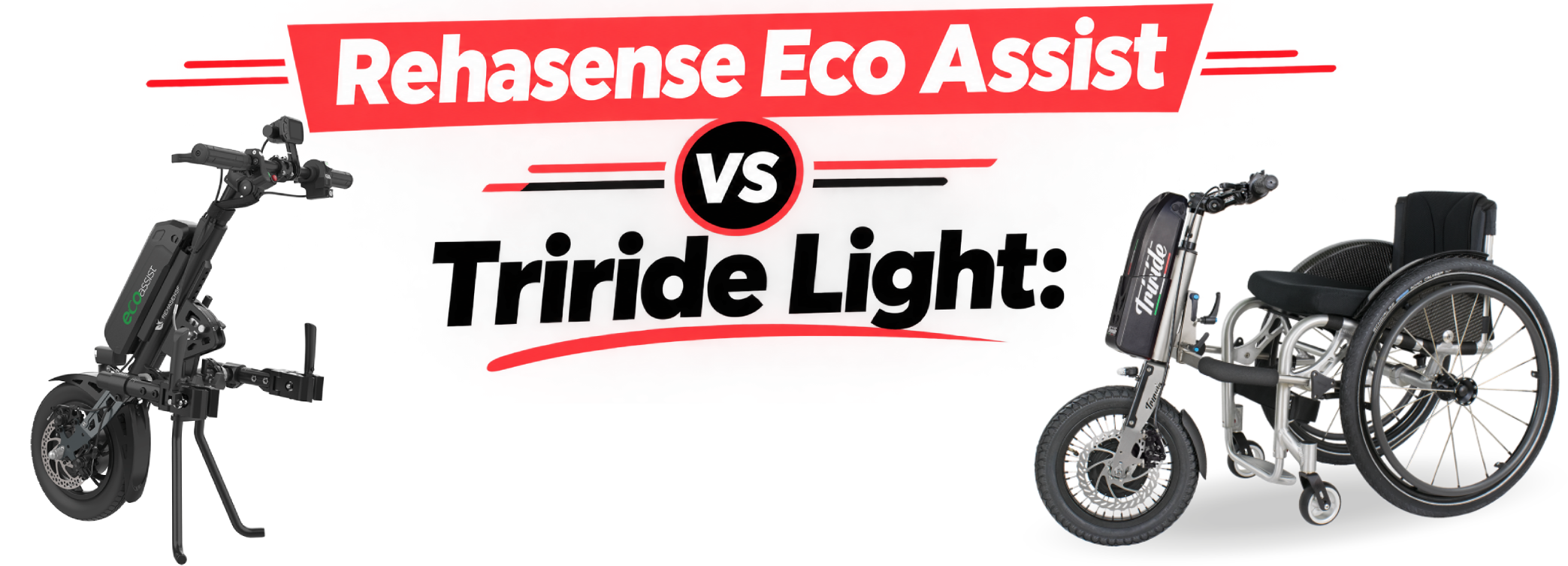
Rehasense Eco Assist vs Triride Light
The best choice depends on your priorities. The Rehasense Eco Assist is worth considering if you want a system with a published 30 km maximum range and a manual docking arrangement. The Triride Light deserves a closer look if a lighter transport configuration and its advertised range of up to 50 km are important to you.
However, the advertised figures tell only part of the story. You also need to consider wheelchair compatibility, battery configuration, the effort required to attach and remove the unit, and how the attachment handles your usual journeys.
This comparison explains the main differences and the questions to ask before arranging a trial.
Want to Try These Products for Yourself?
See how these wheelchair power attachments work for you. Visit our next Roadshow or arrange a personal demonstration.
Try These Products at Our Next Roadshow
Meet the team, explore the products and try them in person at our next Wheelchair Roadshow UK event.
Next Roadshow: 10 April (date to be confirmed)
Register for the Roadshow →Prefer to Try One Now?
Arrange a free home, showroom or online demonstration with Invictus Active at a time that suits you.
No need to wait for the next Roadshow.
Book Your Free Demo →Rehasense Eco Assist vs Triride Light: at a glance
| Feature | Rehasense Eco Assist | Triride Light |
|---|---|---|
| Product type | Front-mounted powered wheelchair add-on | Front-mounted powered wheelchair add-on |
| Published motor information | 350 W motor | Maximum torque of 40 Nm; power depends on specification |
| Published maximum range | Up to 30 km | Up to 50 km |
| Published transport weight | 10 kg | From 8.5 kg |
| Published complete weight | 15.5 kg | A directly comparable complete-system figure was not verified |
| Wheel options | 12-inch class, with 12.5-inch tyre specification in the manual | 12-inch or 14-inch options |
| Battery options | Standard 48 V, 5.8 Ah, 278 Wh; larger battery option advertised | 36 V or 48 V lithium-ion options |
| Braking | Mechanical disc brake and electric brake | Disc brake and electronic regenerative braking |
| Reverse | Yes | Yes |
| Cruise control | Optional | Listed among general features |
| Docking | Manual docking | Confirm the exact attachment and release arrangement with the supplier |
| Wheelchair fit | Manufacturer lists 210–480 mm fitting width | Confirm compatibility for the specific wheelchair and configuration |
Rehasense Eco Assist: what does it offer?
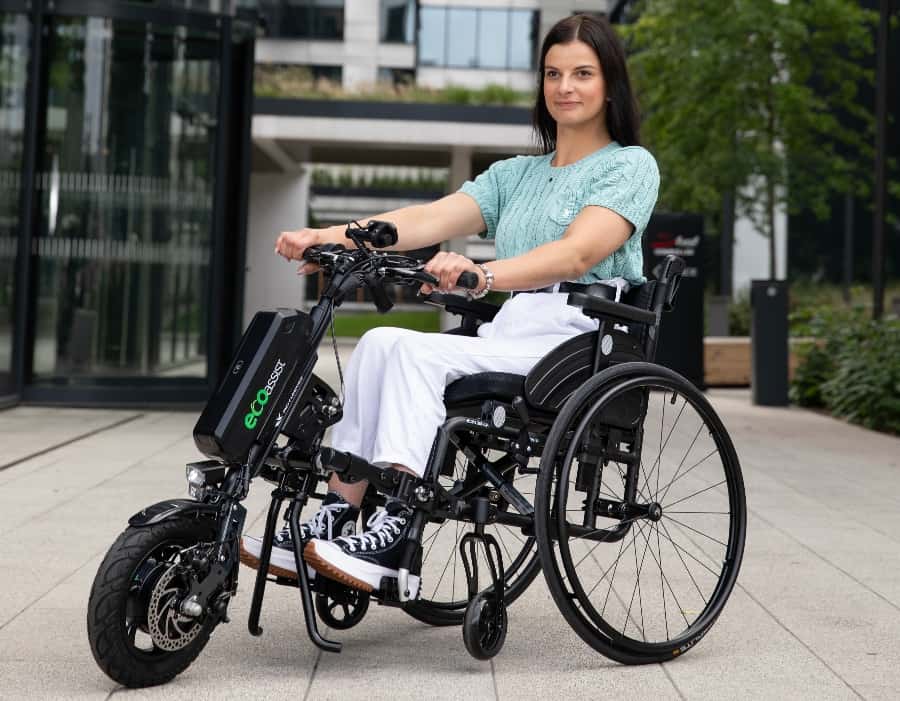
The Rehasense Eco Assist is a powered attachment designed to convert a compatible manual wheelchair into a powered mobility setup. Its manufacturer describes a steel-and-aluminium construction, a 350 W motor and a lithium-ion battery system.
The design includes features intended to support everyday travel, including a walk function, reverse gear, traction control and a twin-brake arrangement. Its manual docking system is another important consideration for anyone who regularly removes the attachment for transport or storage.
Key Eco Assist features
⇒ Standard battery:: 48 V, 5.8 Ah, 278 Wh.
⇒ Advertised maximum range: Up to 30 km.
⇒ Total weight: 15.5 kg.
⇒ Transport weight: 10 kg.
⇒ Braking: Mechanical disc brake and electric brake.
⇒ Additional functions: Reverse, walk function and traction control.
⇒ Mounting: Manual docking system.
⇒ Wheelchair fitting width: 210–480 mm, subject to the manufacturer’s fitting requirements.
The manufacturer also advertises an optional larger battery and optional cruise control. Confirm which features are included in the specific quotation rather than assuming every configuration has the same equipment.
Who should consider the Eco Assist?
⇒ A powered front attachment for suitable everyday journeys.
⇒ A manual docking arrangement that you can operate safely.
⇒ The option of a larger battery, if offered for your chosen specification.
⇒ Reverse and walk functions that suit your intended use.
⇒ A unit that can be disconnected for transport or storage.
The published maximum range should not be treated as a guarantee for your journeys. Hills, frequent stops, the user’s weight, battery condition and other factors affect real-world distance.
Before choosing this attachment, ask for a practical demonstration of docking and removal. You should also confirm the total weight of the exact configuration, because the weight you need to lift and transport may differ from the figure quoted for the main unit alone.
Triride Light: what does it offer?
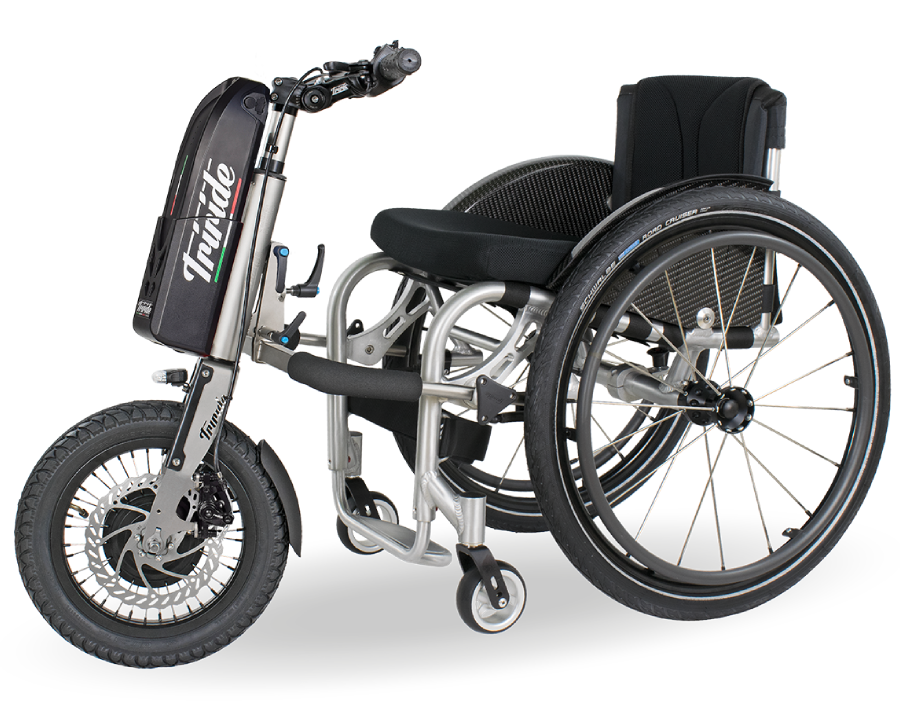
The Triride Light is described by its manufacturer as the entry-level model in the Triride power-device range. It is designed for indoor and outdoor use, with a choice of wheel and battery configurations.
Key Triride Light features
⇒ Wheel options: 12-inch or 14-inch.
⇒ Battery options: 36 V or 48 V lithium-ion.
⇒ Advertised maximum range: Up to 50 km.
⇒ Published transport weight: From 8.5 kg.
⇒ Braking: Disc brake and electronic regenerative braking.
⇒ Controls and functions: LCD display, five selectable power levels, reverse and cruise control.
⇒ Tyre options: City or Cross, according to the manufacturer.
Triride also lists an energy-saving Eco Drive mode and customisable electronics. Options and equipment should be checked against the exact model quotation
Who should consider the Triride Light?
⇒ A choice of 12-inch and 14-inch wheels.
⇒ A system with different battery configurations.
⇒ An advertised maximum range of up to 50 km.
⇒ Multiple selectable power levels.
⇒ Regenerative braking and the associated control features.
⇒ A transport configuration with a published weight from 8.5 kg.
One important detail is that Triride’s 8.5 kg figure is not the weight of every component needed for use. Its technical catalogue states that this figure excludes the battery and wheelchair connection arms. Ask the supplier for the total weight of the precise configuration you would purchase.
Which attachment is lighter to transport?
The Eco Assist has a published transport weight of 10 kg and a total weight of 15.5 kg. The Triride Light is advertised with a transport weight from 8.5 kg, but the manufacturer’s catalogue excludes the battery and wheelchair connection arms from that figure.
This means it would be misleading to declare the Triride Light lighter in every real-world situation based only on those headline figures.
Instead, compare the complete configurations side by side. Ask the supplier to demonstrate how the unit is disconnected, which parts must be lifted separately, and whether the battery can be removed independently.
Also consider where you will store the attachment and how much room it occupies in your vehicle. A lower component weight does not automatically mean the complete setup will be easier for you to manage.
Which offers the longer range?
The published maximum range is up to 30 km for the Eco Assist and up to 50 km for the Triride Light. On paper, the Triride Light has the higher advertised figure.
However, maximum range is not the same as the distance you should plan to travel every day.
Your actual range can depend on:
⇒ The selected battery and its condition.
⇒ User weight and any additional load.
⇒ Hills, gradients and road surfaces.
⇒ Tyre pressure and rolling resistance.
⇒ Speed, acceleration and frequent stopping.
⇒ Temperature and general equipment condition.
For example, a journey with several steep hills and frequent stops may use more battery than a flatter journey of the same length. Always leave a sensible reserve rather than planning to use the full advertised range.
If you regularly travel long distances, ask the supplier to explain which battery configuration is available, how the range estimate was measured and what range might be realistic for your routes.
Motor power, torque and everyday performance
Motor wattage and torque describe different aspects of an electric drive system.
⇒ Motor power, measured in watts, indicates a rate of energy conversion.
⇒ Torque, measured in newton-metres (Nm), describes turning force.
The Eco Assist manufacturer lists a 350 W motor. Triride lists maximum torque of 40 Nm for the Light. These figures alone do not establish which device will accelerate faster, climb a particular hill more effectively or feel more responsive when carrying a specific user.
The complete system matters, including gearing, controller settings, battery configuration, attachment geometry, wheelchair setup and the surface under the wheels.
If your routes include ramps, rough paths or sustained gradients, discuss those exact conditions with the supplier. A controlled demonstration on a safe, representative route is more useful than relying on one specification number.
Wheelchair compatibility and fitting
The Eco Assist manufacturer lists compatibility with rigid and folding wheelchairs that have a fixed front frame. Its published fitting dimensions include a width range of 210–480 mm and a clamp fitting height range of 260–420 mm. These are fitting parameters, not a guarantee of compatibility with every wheelchair within those measurements.
For the Triride Light, do not assume that the availability of different wheels or battery options means it will fit your wheelchair. The supplier needs to confirm the mounting hardware and configuration for your particular chair.
Before ordering either device, confirm:
⇒ Your wheelchair make and exact model.
⇒ Frame dimensions and the required mounting points.
⇒ Whether your frame design is compatible.
⇒ The proposed attachment and release mechanism.
⇒ Any clearance issues involving footrests, leg supports or other components.
⇒ The total user-weight limit and any applicable system limits.
⇒ Whether fitting changes the handling or turning characteristics of your wheelchair.
A qualified supplier should assess the complete wheelchair-and-attachment combination and explain any relevant restrictions before you buy.
Controls, braking and ease of use
The Eco Assist includes a mechanical disc brake and electric braking, along with reverse and walk functions. Triride lists disc braking, regenerative braking, reverse, cruise control and five selectable power levels.
When comparing the controls, consider more than the number of functions available. Think about whether you can reach and operate them comfortably, understand the display and manage the device in busy or confined spaces.
Ask to try the controls under supervision. If you have specific requirements for hand control, grip, reach or other adaptations, ask the supplier whether the relevant configuration is supported and whether additional options are needed.
Braking behaviour also deserves a practical assessment. Ask the supplier to explain how the brakes work, what happens when the battery is low and how the device should be used on slopes. Do not assume that regenerative braking replaces the need to understand the manufacturer’s braking instructions.
Which should you choose?
There is no universal winner. The right choice depends on how you use your wheelchair, what you can comfortably manage and whether the attachment fits your particular frame.
| Your priority | What to investigate |
|---|---|
| A longer advertised maximum range | The Triride Light's published figure of up to 50 km, while checking realistic range for your routes. |
| A manual docking arrangement | How the Eco Assist connects and disconnects, and whether you can manage it safely. |
| Lower transport weight | Complete ready-to-use and transport weights for both configurations. |
| Different wheel options | The Triride Light's listed 12-inch and 14-inch configurations. |
| Everyday travel with reverse and walk functions | Whether the Eco Assist's features suit your intended use. |
| Different power settings and regenerative braking | The Triride Light's controls and braking behaviour. |
| A particular wheelchair frame | A formal compatibility check for either product. |
| Best overall value | Comparable written quotations, including fitting, accessories and servicing. |
Our recommendation
The Eco Assist is worth considering if its manual docking system and available features suit your needs. The Triride Light is worth considering if its configuration options, controls and advertised range better match your intended journeys.
Before deciding, try the attachment on your own wheelchair wherever possible. Ask for an assessment that covers mounting, turning, braking, reversing, removing the unit and loading it for transport.
Final thoughts
Compare the complete systems, verify fitment and try the controls before making a decision. A well-matched attachment should suit your wheelchair, your daily journeys and the way you need to transport and manage the equipment.
WHEELCHAIR ROADSHOW UK
Want to try one for yourself?
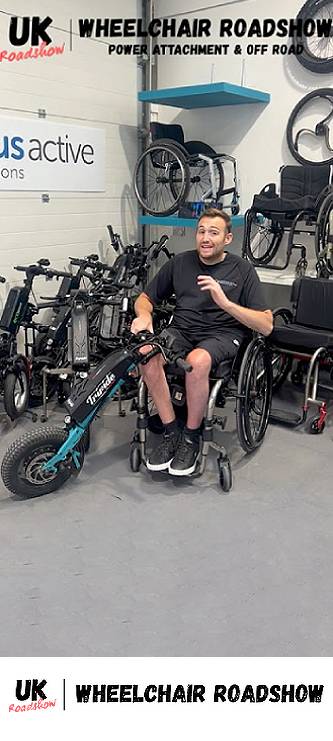
Come along to a future Wheelchair Roadshow UK event to explore wheelchair power attachments and mobility equipment in person. Prefer to speak to someone sooner? You can request a free demonstration, subject to availability.
This button will be activated once the demonstration form is available.
Frequently Asked Questions
Is the Triride Light lighter than the Rehasense Eco Assist?
The Triride Light is advertised with a transport weight from 8.5 kg, while the Eco Assist has a published transport weight of 10 kg. However, the Triride figure excludes the battery and wheelchair connection arms, so these numbers do not represent equivalent complete systems. Ask for the complete weight of each configuration
Which has the longer advertised range?
The Eco Assist is advertised with a maximum range of up to 30 km. The Triride Light is advertised with a maximum range of up to 50 km. These are manufacturer figures rather than results from a controlled comparison, and actual range varies with use and conditions.
Can either attachment fit a folding wheelchair?
The Eco Assist manufacturer specifies compatibility with rigid and folding wheelchairs that have a fixed front frame. Compatibility with an individual chair still needs to be confirmed. For the Triride Light, ask the supplier to check your wheelchair model, frame dimensions and mounting arrangement before ordering.
Does a 350 W motor mean the Eco Assist is more powerful?
Not necessarily. Wattage and torque measure different things, and the available specifications are not enough to rank overall performance. Ask the supplier to assess the complete setup and demonstrate it under conditions relevant to your usual journeys.
Can the advertised maximum range be achieved on every journey?
No. Maximum range is dependent on factors such as battery configuration, terrain, user weight, speed and driving conditions. Plan around a realistic range for your journeys and retain a suitable battery reserve.
What should I check before buying a wheelchair power attachment?
Confirm compatibility, user-weight limits, total and transport weight, docking and removal, controls, braking, battery options, realistic range, servicing and warranty. Arrange a practical demonstration and ask for a written quotation covering the configuration you intend to use.