Can You Fit a Rehasense PAWS to a Folding Wheelchair?
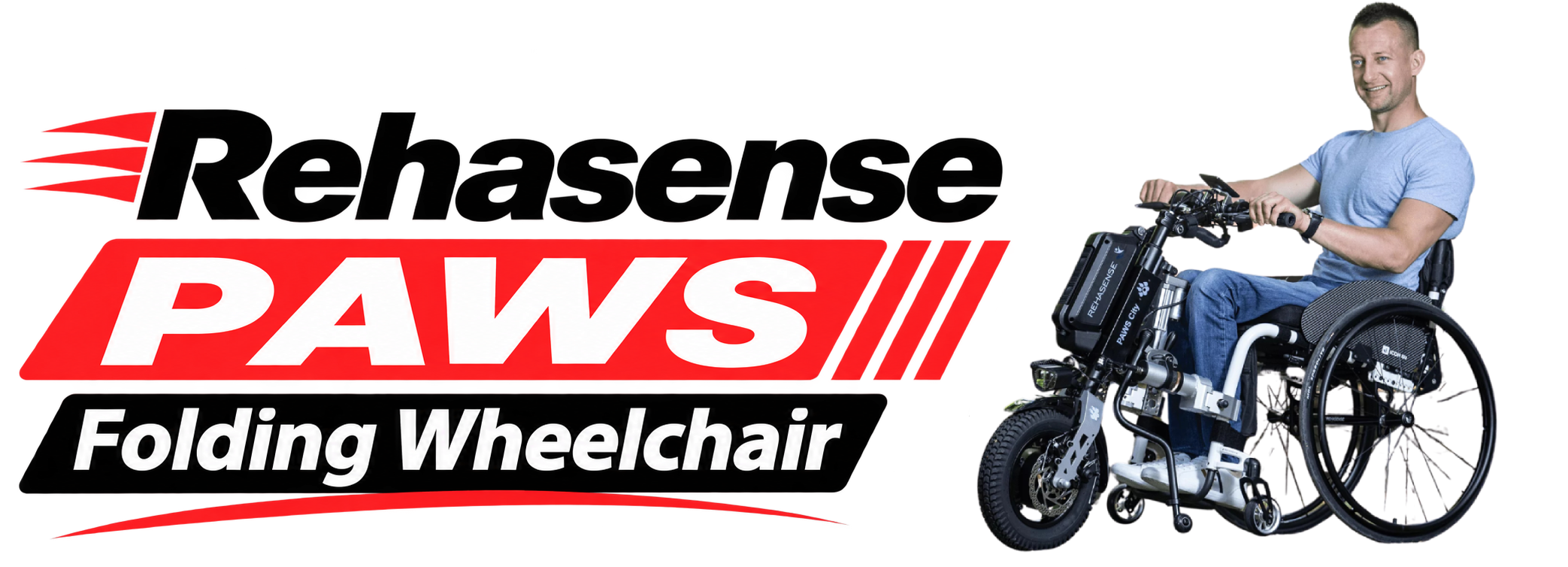
Rehasense PAWS folding wheelchair
If you use a folding wheelchair, you might assume that adding a powered attachment means changing to a rigid-frame wheelchair. Fortunately, that is not necessarily the case.
Yes, a Rehasense PAWS can be fitted to certain folding wheelchairs. Rehasense designed the PAWS system for use with both folding and rigid-frame manual wheelchairs. However, compatibility depends on the wheelchair’s frame construction, clamp positioning and ability to withstand the additional forces created during powered use.
This means that not every folding wheelchair will automatically be suitable.
Before choosing a Rehasense PAWS, it is important to understand how its attachment system works, which frame measurements matter and what a specialist needs to check. Here is what wheelchair users should know before arranging a fitting.
Want to Try These Products for Yourself?
See how these wheelchair power attachments work for you. Visit our next Roadshow or arrange a personal demonstration.
Try These Products at Our Next Roadshow
Meet the team, explore the products and try them in person at our next Wheelchair Roadshow UK event.
Next Roadshow: 10 April (date to be confirmed)
Register for the Roadshow →Prefer to Try One Now?
Arrange a free home, showroom or online demonstration with Invictus Active at a time that suits you.
No need to wait for the next Roadshow.
Book Your Free Demo →Can a Rehasense PAWS Fit a Folding Wheelchair?
Yes. The Rehasense PAWS user manual specifically identifies folding and rigid-frame wheelchairs as suitable types for its intended application.
The system connects to the front frame of a manual wheelchair using a specially designed clamping mechanism. Once correctly fitted, the front-mounted power attachment provides powered assistance for travelling.
The important distinction is that compatibility is determined by the wheelchair’s construction rather than simply whether it folds.
A folding wheelchair must have suitable frame sections where the PAWS clamps can connect securely. Its frame must also be strong enough to handle the forces generated during operation.
Rehasense provides different clamping solutions for various wheelchair frame profiles. This allows an authorised specialist to assess more than just conventional round tubing.
Therefore, owning a folding wheelchair does not automatically rule out using a PAWS attachment.
How Does the Rehasense PAWS Attach to a Folding Wheelchair?
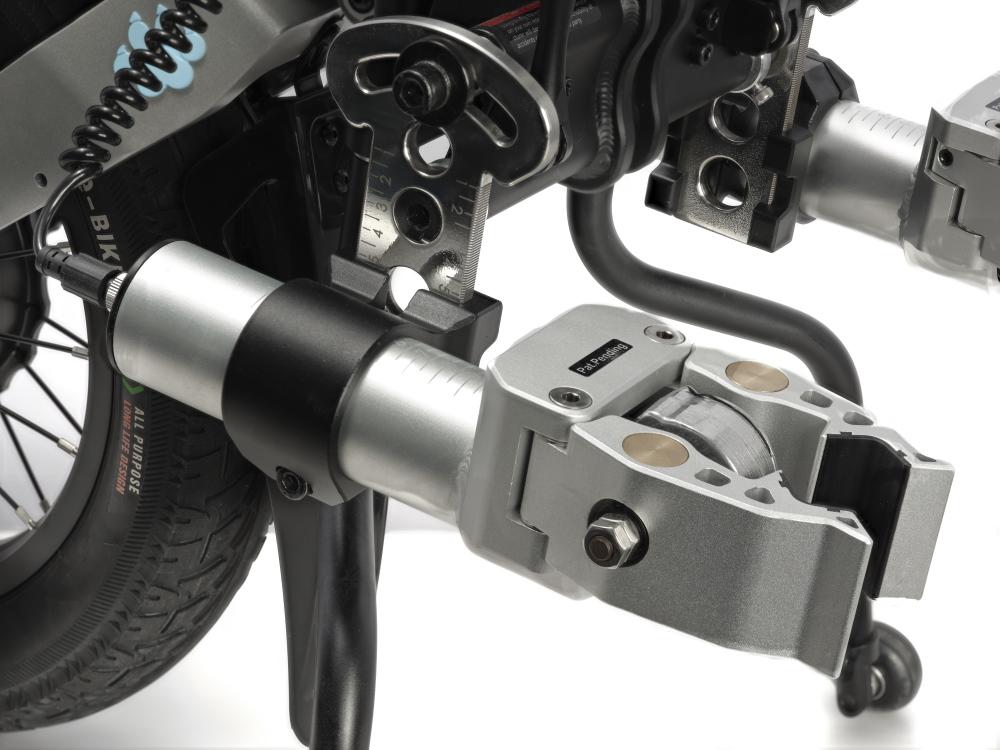
The PAWS connects to the wheelchair’s front frame through a docking and clamping arrangement.
Depending on the selected configuration, the system can use manual or automatic clamping and lifting functions.
The attachment process involves positioning the wheelchair correctly, aligning the clamp mechanism with the appropriate frame sections and adjusting the connection.
The specialist must ensure that both sides are correctly positioned and that the attachment remains secure.
Manual and automatic clamping options
⇒ Manual clamp and lift: The user operates the manual clamping and lifting mechanism.
⇒ Automatic lift with manual clamp: The lifting function is automatic, while clamping is performed manually.
⇒ Automatic clamp and lift: Both functions are automated.
The available configuration should be confirmed with the supplier for the particular PAWS model.
Automatic clamping does not remove the need for a suitable wheelchair frame. The underlying compatibility requirements still apply.
What Makes a Folding Wheelchair Compatible with PAWS?
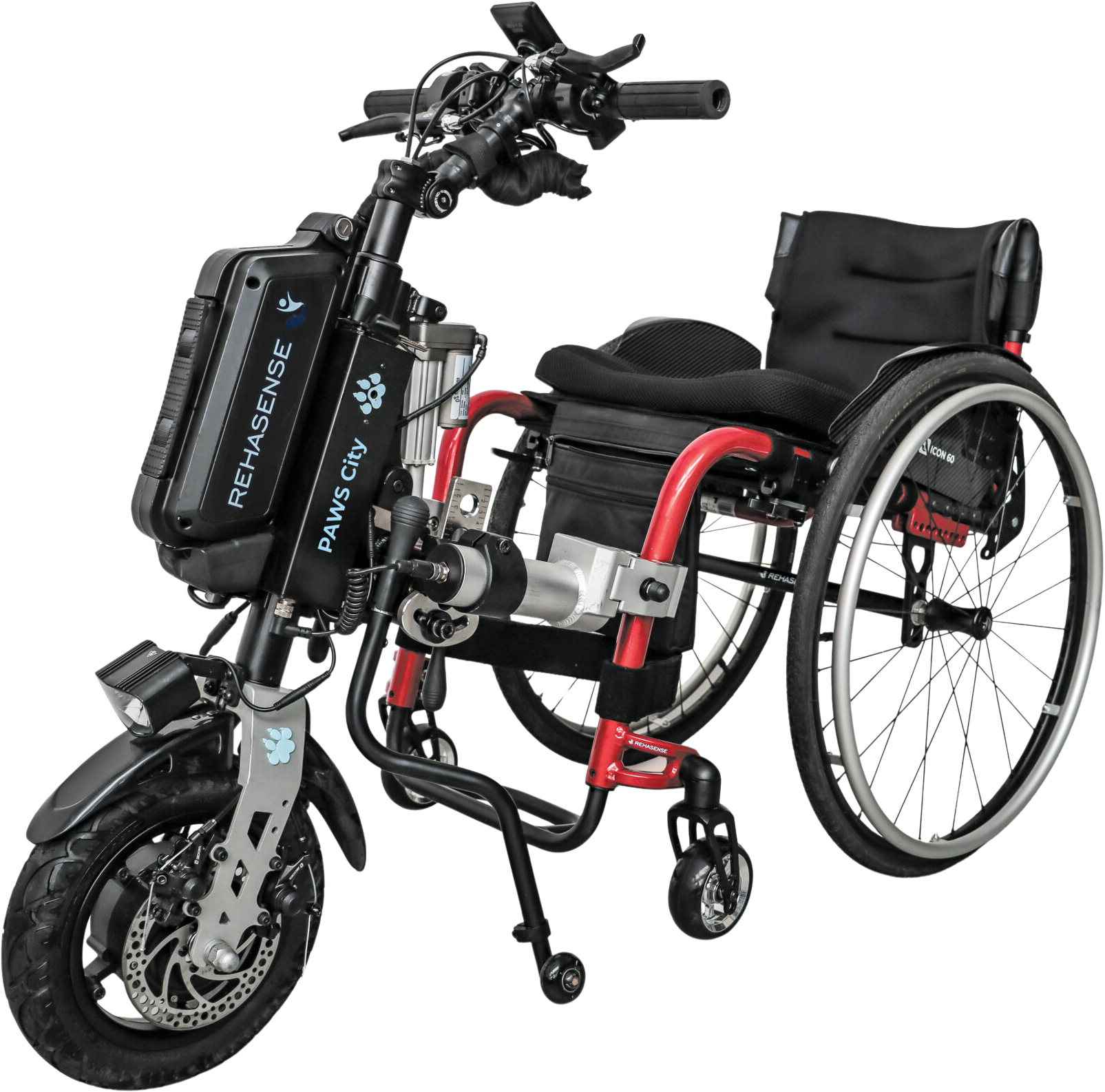
There are several important factors to consider before fitting a PAWS attachment.
The manufacturer’s Compatibility and Connection Table (CCT) provides technical guidance for checking the wheelchair frame and its connection points.
1. Wheelchair frame material
The PAWS manual identifies high-grade aluminium alloy frames, including 6061-T6 and 7005-T6, as suitable materials within its stated connection requirements. It also identifies certain titanium alloy frames.
Carbon fibre and other composite materials require particular caution.
The manufacturer advises against pairing PAWS with composite fibre frames in the manual because of concerns about compressive forces. Its current PAWS website also specifically warns against using the system with carbon fibre wheelchairs.
Do not assume that a carbon fibre wheelchair can be made compatible simply by changing the clamp.
2. Frame tube diameter
⇒ Minimum tube diameter: 19 mm.
⇒ Maximum tube diameter: 40 mm.
These measurements relate to the main side or anterior wheelchair frame tube connection.
A folding wheelchair with tubing outside this range should not be assumed compatible without confirmation of an appropriate manufacturer-approved interface.
3. Frame wall thickness
This matters because the clamping mechanism applies pressure to the wheelchair frame.
A frame that appears strong externally may not have the required wall thickness. Therefore, visual inspection alone cannot establish compatibility.
4. Distance between clamping points
The specialist must check the actual distance between the suitable connection points on the wheelchair.
This is particularly important because folding wheelchair designs can have different frame geometries.
5. Straight frame sections
This allows the clamp to sit correctly against the frame.
A curved, tapered or obstructed section may prevent the required connection. An alternative interface may be necessary, subject to manufacturer approval.
PAWS wheelchair frame compatibility requirements
The following table summarises the standard connection requirements published in the Rehasense PAWS user manual (Version 10/21).
| Compatibility Requirement | Manufacturer's Published Information |
|---|---|
| Round frame tube diameter | 19–40 mm |
| Minimum tube wall thickness | 1.2 mm |
| Aluminium frame material | 6061-T6 or 7005-T6 high-grade alloy |
| Other listed frame material | Certain titanium alloy frames |
| Clamping point width | 230–530 mm, depending on adaptor |
| Straight tube section | Minimum 50 mm without bends |
| Clamping force | 2,000 N |
| Irregular frame profiles | Suitable interface adaptor may be required |
These are published connection parameters, not an automatic approval of a particular wheelchair. The complete wheelchair and proposed PAWS interface must be assessed by an authorised PAWS distributor.
Why Does the Folding Mechanism Matter?
Unlike a rigid-frame wheelchair, a folding wheelchair has a mechanism that allows its frame to change configuration.
This does not necessarily prevent a PAWS attachment from being fitted. However, the specialist needs to establish whether the selected clamping points remain suitable and whether the attachment interferes with the folding mechanism.
Several areas deserve attention.
Folding cross-braces and moving components
These components should not be confused with suitable PAWS attachment points.
The specialist needs to identify the correct front frame sections rather than attaching the clamps to an unsuitable structural component.
Frame movement and connection stability
Any movement, deformation or damage around the clamping area needs to be investigated.
The clamp must maintain its intended connection without interfering with the wheelchair’s construction.
Folding and unfolding after fitting
The answer may depend on the particular wheelchair and its configuration.
Do not assume that every chair will fold in exactly the same way once an attachment has been installed.
Does Using PAWS Mean You Need to Modify Your Folding Wheelchair?
The PAWS system is designed around a removable docking arrangement rather than requiring users to convert their manual wheelchair into a permanently powered chair.
However, the exact fitting arrangement depends on the wheelchair and the interface selected.
Some wheelchairs may require a particular clamp or approved interface to accommodate their frame profile.
Rehasense provides specialist clamping solutions for different frame designs, including certain non-round profiles.
The manufacturer should confirm whether the proposed arrangement is approved for the specific wheelchair.
Avoid drilling, welding, cutting or modifying the frame independently to make an attachment fit.
Any proposed modification should be discussed with the wheelchair manufacturer and authorised PAWS distributor first.
Which Folding Wheelchairs Can Be Used with Rehasense PAWS?
Two wheelchairs from the same manufacturer can have different frame materials, tubing dimensions and front-frame configurations.
These differences can affect whether the PAWS clamp can be fitted safely.
The following table explains what needs to be considered when assessing different folding wheelchair designs.
| Folding Wheelchair Design | What Needs Checking |
|---|---|
| Aluminium folding wheelchair | Frame alloy, tube diameter, wall thickness and clamp position |
| Lightweight folding wheelchair | Frame strength and suitability for additional clamping forces |
| Titanium folding wheelchair | Exact frame construction and approved connection interface |
| Carbon fibre folding wheelchair | Manufacturer's warning against composite frame pairing |
| Folding wheelchair with oval tubing | Availability of an approved specialist clamp |
| Folding wheelchair with unusual frame geometry | Clamp alignment, available straight sections and structural suitability |
This is a general assessment guide, not a list of approved wheelchair models. For an individual recommendation, provide the wheelchair make, model and frame specifications to an authorised PAWS distributor.
Does a Folding Wheelchair Need a Stronger Frame for PAWS?
The important issue is not simply whether a wheelchair is classified as lightweight or heavy-duty.
It is whether its frame and construction can safely withstand the additional forces associated with a powered front attachment.
The PAWS manual explains that using a powered drive system can expose a wheelchair to greater wear than ordinary manual propulsion.
This is particularly relevant when travelling longer distances or using unsealed surfaces.
Rehasense also recommends regular inspections of the wheelchair frame, including checks for bending, indentation, cracks and other damage.
For this reason, wheelchair compatibility should be considered alongside ongoing maintenance and the wheelchair manufacturer’s warranty conditions.
Before purchasing PAWS, contact your wheelchair supplier to establish whether using a powered attachment affects the chair’s warranty or servicing requirements.
How Is a Rehasense PAWS Fitted to a Folding Wheelchair?
The authorised PAWS distributor must assess the wheelchair, select the appropriate connection interface and complete the necessary adjustments.
The general process involves the following stages.
Identify the wheelchair: Confirm its manufacturer, model, frame material and construction.
Inspect the frame: Check the proposed clamping areas for damage, bends, obstructions and unsuitable profiles.
Measure the connection points: Record the relevant tube dimensions, straight sections and clamping width.
Select the correct interface: Establish whether the standard clamp or a specialist adaptor is required.
Complete the fitting: Position and adjust the clamp mechanism according to the manufacturer’s instructions.
Check the connection: Verify the alignment, stability and correct operation of the complete assembly.
Provide user instruction: Ensure the user understands docking, undocking, handling and safety requirements.
The PAWS manual states that coupling between a third-party wheelchair and the device must be performed by an authorised PAWS distributor.
This is particularly important when dealing with folding wheelchairs that have unusual frame designs.
Important Safety Considerations Before Using PAWS
Compatibility is only one part of the decision.
A wheelchair that accepts the correct clamp must also remain suitable for the additional loads and forces associated with powered operation.
Before using the attachment, consider the following points.
Wheelchair warranty: Ask the wheelchair manufacturer whether powered attachment use affects its warranty.
Frame condition: Check for cracks, dents, bending and other signs of structural damage.
Rear wheels: Ensure the wheels, spokes, tyres and axles are in suitable condition.
Clamp inspection: Check for slipping, excessive markings or changes in clamping behaviour.
Regular servicing: Follow the maintenance requirements for both the wheelchair and PAWS.
User training: Receive appropriate instruction from a trained product specialist.
The manufacturer also recommends familiarisation and driving training before using the system independently.
The combined wheelchair and PAWS system handles differently from a conventional manual wheelchair, particularly when turning, negotiating slopes and travelling over uneven surfaces.
Is Rehasense PAWS a Good Option for Someone Who Uses a Folding Wheelchair?
It can be worth considering if you want to retain your existing folding wheelchair while exploring powered mobility.
The main advantage is that a folding frame does not automatically exclude you from using the PAWS system.
However, the suitability of the complete arrangement needs to be established first.
Potential advantages
⇒ You may be able to keep using your existing manual wheelchair.
⇒ PAWS is designed for both folding and rigid-frame wheelchair applications.
⇒ Different clamping solutions are available for various frame profiles.
⇒ The docking arrangement allows the power attachment to be connected and disconnected.
⇒ Different PAWS configurations offer manual and automated docking functions.
Important limitations
⇒ Not every folding wheelchair will be compatible.
⇒ Frame material and construction can restrict fitting options.
⇒ Some frame profiles may require specialist adaptors.
⇒ Carbon fibre wheelchairs are not recommended by the manufacturer.
⇒ Additional stresses and wear need to be considered.
⇒ Compatibility must be confirmed by an authorised PAWS distributor.
The best approach is to have your actual wheelchair assessed rather than choosing an attachment based on photographs or general product descriptions.
What Information Should You Provide Before Requesting a PAWS Compatibility Check?
If you are interested in fitting a Rehasense PAWS to your folding wheelchair, preparing a few details can help the supplier assess your requirements.
Ideally, provide:
⇒ Wheelchair manufacturer and model.
⇒ Approximate age of the wheelchair.
⇒ Frame material, if known.
⇒ Photographs of the front frame from both sides.
⇒ Photographs showing the folding mechanism.
⇒ Any available technical specifications or frame measurements.
⇒ Your preferred PAWS model, if you have already selected one.
Do not attempt to measure or adjust the clamping force yourself.
The supplier can advise which additional measurements are required and whether the wheelchair needs a physical inspection.
Final Thoughts: Check Compatibility Before Choosing Your PAWS
A folding wheelchair does not automatically prevent you from using a Rehasense PAWS power attachment.
The manufacturer specifically designed the system for folding as well as rigid-frame wheelchairs.
However, successful fitting depends on the frame material, tube dimensions, clamp positioning and overall structural suitability.
Rather than replacing your wheelchair immediately, ask an authorised PAWS distributor to assess your existing chair.
A professional compatibility check can establish whether the correct clamp is available and whether your wheelchair is suitable for powered use.
WHEELCHAIR ROADSHOW UK
Want to try one for yourself?
Come along to a future Wheelchair Roadshow UK event to explore wheelchair power attachments and mobility equipment in person. Prefer to speak to someone sooner? You can request a free demonstration, subject to availability.
This button will be activated once the demonstration form is available.