Rehasense PAWS vs Triride: Which Wheelchair Power Attachment Should You Choose?
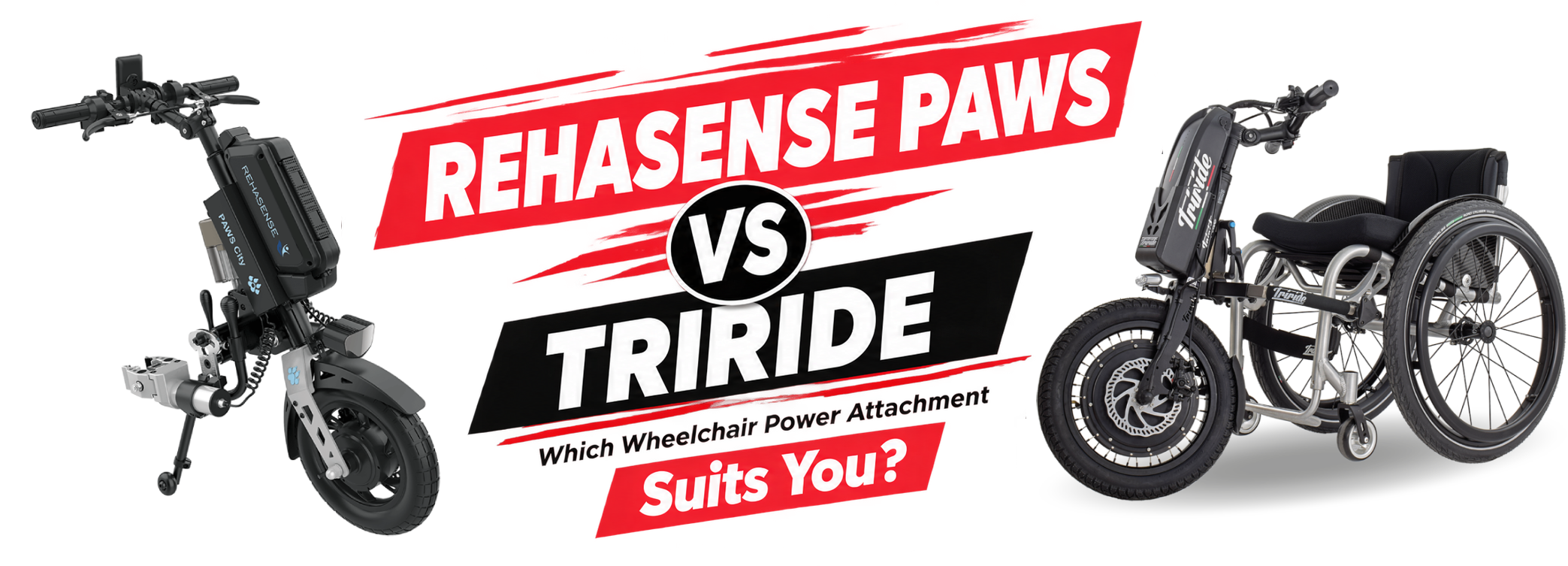
Rehasense PAWS vs Triride
But which is the better choice?
The answer depends on the particular models, your wheelchair’s compatibility, how you plan to use the attachment and how comfortable you feel controlling it. PAWS offers several configurations, including City, Cruiser and Tourer models. Triride also has a broad range, from the Light to more powerful configurations such as the Special Compact HT.
Rather than choosing by brand name alone, compare the features that matter in your everyday life.
Want to Try These Products for Yourself?
See how these wheelchair power attachments work for you. Visit our next Roadshow or arrange a personal demonstration.
Try These Products at Our Next Roadshow
Meet the team, explore the products and try them in person at our next Wheelchair Roadshow UK event.
Next Roadshow: 10 April (date to be confirmed)
Register for the Roadshow →Prefer to Try One Now?
Arrange a free home, showroom or online demonstration with Invictus Active at a time that suits you.
No need to wait for the next Roadshow.
Book Your Free Demo →Rehasense PAWS vs Triride: key differences
Both brands offer powered attachments designed to provide motorised assistance to a compatible manual wheelchair. However, their product ranges include different wheel sizes, power characteristics and configurations.
| What to compare | Rehasense PAWS | Triride |
|---|---|---|
| Range | City, Cruiser and Tourer configurations | Light, Special Light, Compact HT and other models |
| Wheel sizes | Options from 12 to 20 inches across the range | Varies by model |
| Motor or torque specification | Varies by PAWS model | Varies by Triride model |
| Compatibility | Model-specific clamps and fitting options | Confirm model-specific fitting and compatibility |
| Everyday use | Consider City and other configurations against your routes | Consider Light and other configurations against your needs |
| Rougher surfaces | Assess the selected wheel and configuration against the terrain | Assess the selected device and wheel configuration against the terrain |
| Portability | Consider the complete unit's weight and how it will be transported | Check the exact device's weight and how it can be dismantled or transported |
| Best choice | Depends on fit, controls, transport and intended use | Depends on fit, controls, transport and intended use |
The table is a starting point, not a verdict. A comparison between PAWS City and Triride Light, for example, is more useful than comparing the entire PAWS range against one Triride model.
What is the Rehasense PAWS wheelchair power attachment?
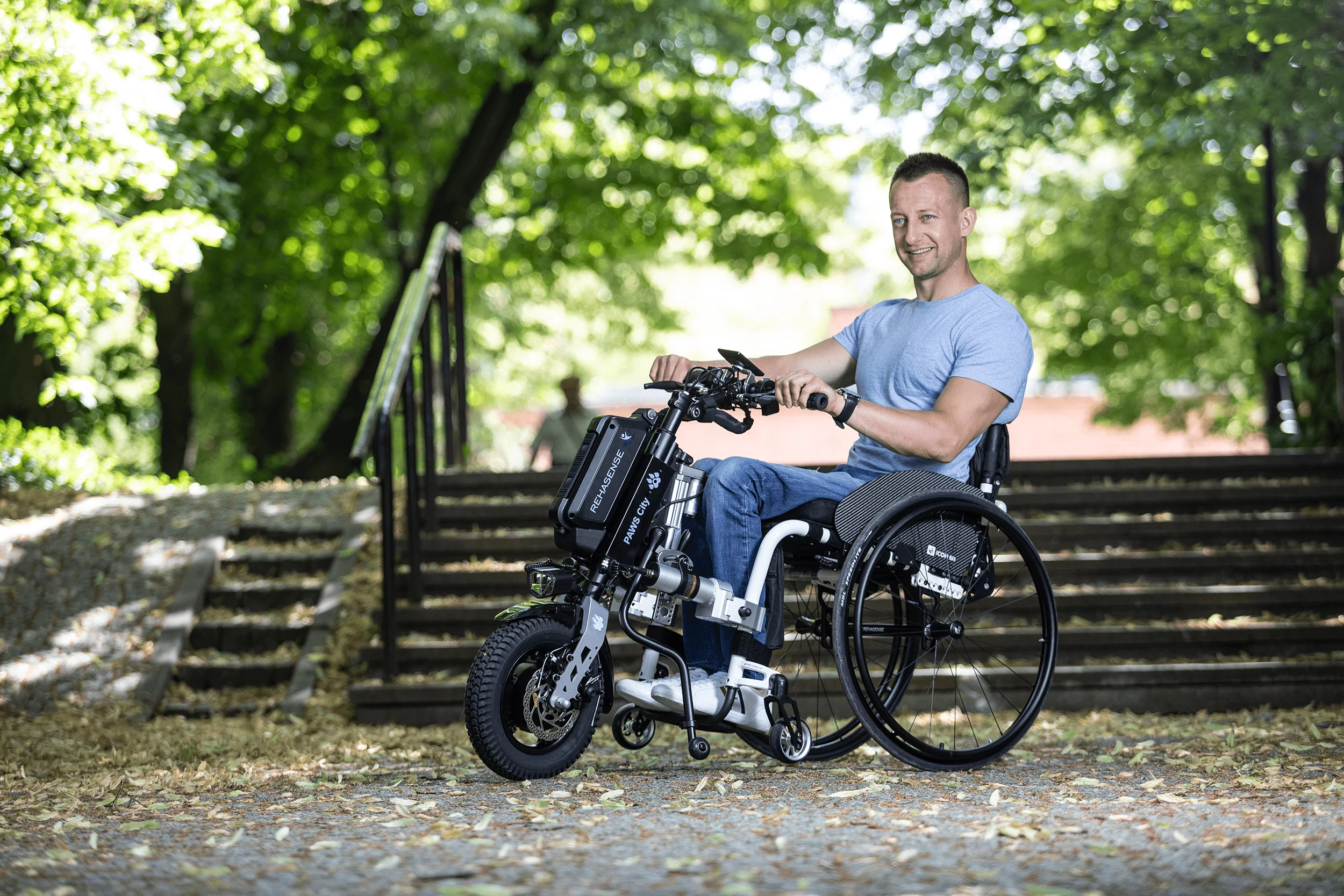
Rehasense PAWS stands for Power Assisted Wheelchair System. It is a front-mounted powered attachment designed to connect to a compatible manual wheelchair.
The attachment provides a powered drive wheel and handlebars, allowing the user to steer and control the system while seated in the wheelchair.
The range includes several configurations designed around different use cases.
PAWS City
The City is described by the manufacturer as a configuration intended for urban driving and smoother surfaces. Its compact design and small turning circle are relevant considerations for people who regularly navigate town centres or tighter spaces.
The official specification table lists:
⇒ A 12-inch or 14-inch drive wheel, depending on configuration.
⇒ A 350 W motor for the City 12-inch model and 400 W for the City 14-inch model.
⇒ A listed maximum range of up to 40 km under the manufacturer’s stated conditions.
⇒ A turning radius of approximately 100 cm for the 12-inch version and 110 cm for the 14-inch version.
These are manufacturer-published figures, not guaranteed real-world results. Actual range can vary with terrain, user and wheelchair weight, battery condition, temperature and riding style.
PAWS Cruiser and Tourer
This makes wheel configuration an important part of the comparison. However, a larger wheel or a higher motor rating alone does not establish that a particular attachment will be more suitable for a specific route.
Before choosing, discuss your usual surfaces, slopes, kerbs and travel distances with a knowledgeable supplier.
PAWS controls and attachment options
These features may be particularly relevant if you have difficulty gripping, reaching or operating conventional controls.
Compatibility must still be checked for the exact wheelchair. Rehasense specifically advises against using PAWS with carbon-fibre wheelchairs because of potential damage concerns. Contact the manufacturer or an authorised supplier if your frame material or shape is uncertain.
What is a Triride wheelchair power attachment?
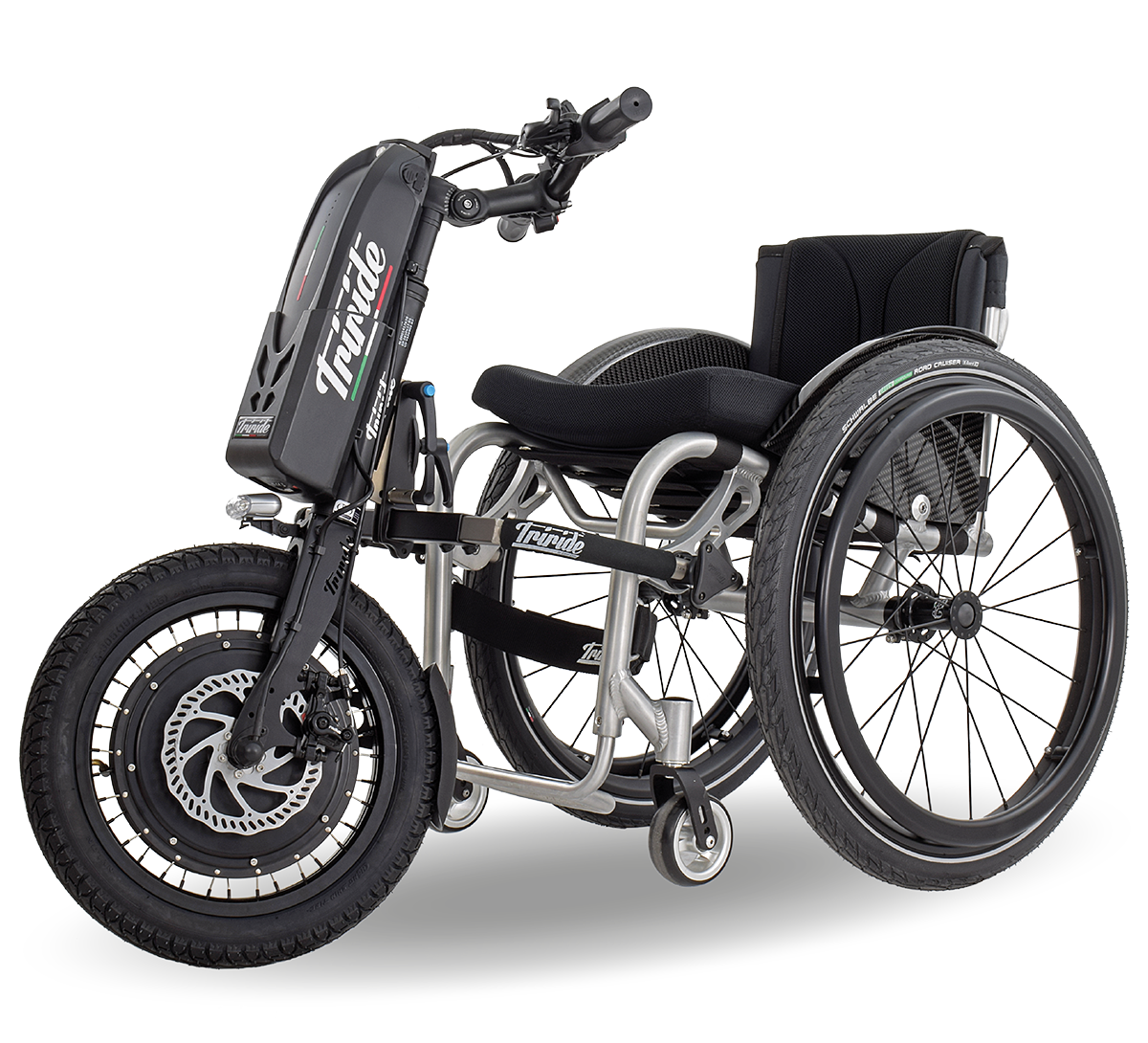
Triride manufactures a range of traction devices that attach to manual wheelchairs, providing powered assistance through a front wheel and steering controls.
The important distinction is that Triride is a range rather than a single specification. Different models are designed around different combinations of wheel size, torque and intended use.
Triride Light
The manufacturer’s UK-facing product range lists the Triride Light with:
⇒ A 12-inch or 14-inch wheel option.
⇒ A published torque rating of 40 Nm.
Torque describes the turning force produced by the motor. It is one factor that can influence how an attachment responds under load, particularly on inclines, but it is not a complete measure of real-world performance.
The Light may be a useful model to investigate if you are comparing compact front-mounted attachments for everyday travel. Its suitability still depends on your wheelchair, control requirements, local terrain and transport arrangements.
Triride Special Light
That is a higher published torque figure than the standard Light, but it does not automatically make the Special Light the right choice for you. Consider the whole configuration, including weight, controls, battery options, handling and the manufacturer’s intended use.
Other Triride models
Their specifications and intended applications differ. If you need a particular wheel size or performance characteristic, compare the precise model and configuration rather than assuming that all Triride attachments share the Light’s specifications.
See the official Triride power device range for the manufacturer’s current model information.
PAWS vs Triride: which is easier to transport?
Before buying, work out how the device will travel with you. Will it stay attached to your wheelchair, be removed for a car journey or be stored separately at home?
Check the complete weight
These are weights for the complete attachment as specified, not a promise that the device will be easy for one person to lift.
For Triride, obtain the total weight of your selected model and any battery or accessories you intend to use. I could not establish a directly comparable, complete model-by-model weight table from the official Triride range page retrieved for this article.
Think about loading and unloading
⇒ Whether you can manage the clamps and controls independently.
⇒ How much lifting is required.
⇒ Whether the device can be dismantled for your vehicle.
⇒ Whether you have enough storage space.
⇒ Whether any additional equipment or assistance is needed.
Do not choose on the basis of a headline product weight alone. Your ability to lift, reach and secure the attachment matters just as much.
Which attachment is better for everyday journeys?
For town centres and smoother paths
If you frequently visit shops or navigate narrow routes, ask to try the device in an environment that resembles your everyday journeys.
For longer journeys
The PAWS manufacturer lists a maximum range of up to 40 km for selected configurations under specified conditions. A fair Triride comparison requires a verified range figure for the exact model and battery you are considering.
Think about your typical journey length, opportunities to recharge and the effect of hills, surface conditions and additional load.
For uneven surfaces
Do not assume that any front attachment will handle every kerb, ramp, loose surface or steep incline safely. Ask the supplier which terrain the specific model is designed for and which obstacles it can safely negotiate.
Where possible, try the attachment on representative surfaces under appropriate supervision.
Compatibility: will PAWS or Triride fit your wheelchair?
A powered attachment must connect securely to your wheelchair and work safely with its frame, geometry, brakes and configuration.
Ask the supplier to confirm:
⇒ Your wheelchair make, model and frame material.
⇒ Whether the required clamps and fittings are available.
⇒ Whether any frame modifications or additional accessories are necessary.
⇒ Whether the attachment can be connected and disconnected safely.
⇒ Whether the combined configuration respects the manufacturer’s weight limits.
⇒ Whether the handlebar and controls can be positioned appropriately for you.
For PAWS, the manufacturer describes a variety of clamping solutions but advises against use with carbon-fibre wheelchairs. For Triride, obtain confirmation for your exact wheelchair and selected device rather than assuming that compatibility with one model guarantees compatibility with another.
Controls, comfort and accessibility
Consider your grip, arm movement, posture, vision and ability to use the brakes and controls. If you have reduced hand function, ask whether adapted controls are available for the exact model.
PAWS describes specialist controls and adjustable handlebar positioning as features of its range. Triride also offers model-specific configurations and customisation options, so ask the supplier to explain what can be adapted to your requirements. Do not assume every option is included as standard.
A proper demonstration should allow you to assess:
⇒ Steering and turning in confined spaces.
⇒ Starting, stopping and changing speed.
⇒ Braking and control placement.
⇒ Manoeuvring on your usual types of surface.
⇒ Attaching and removing the unit.
⇒ Comfort over a realistic journey.
If possible, take your own wheelchair to the assessment. This allows the supplier to evaluate the actual combination rather than a demonstration setup that may differ from yours.
What should you compare before making a decision?
Use the following checklist when speaking to a supplier.
| Question | Why it matters |
|---|---|
| Which exact model is being offered? | Brand-level comparisons can hide substantial differences. |
| Does it fit my wheelchair? | Secure, compatible fitting is essential. |
| What is the total weight? | Important for lifting, transport and storage. |
| What range is realistic for my journeys? | Manufacturer figures may differ from everyday results. |
| Are the controls suitable for my hands and reach? | Comfort and safe operation depend on the user. |
| What terrain is the device designed for? | Not every model suits every surface or incline. |
| What is included in the quoted price? | Batteries, clamps and accessories can vary. |
| What maintenance and warranty apply? | Check the specific model and supplier terms. |
| Can I try the attachment before buying? | A practical assessment can reveal issues that specifications cannot. |
Which is better: Rehasense PAWS or Triride?
PAWS is worth investigating if you want to compare its City, Cruiser and Tourer configurations, including its documented automatic clamp and lift features. Triride is worth investigating if you want to compare a broad selection of traction devices with different wheel sizes and torque ratings.
The best choice is the exact model that fits your wheelchair, suits your control needs, works for your typical journeys and can be transported and maintained safely.
Before making a final decision, ask a supplier to confirm compatibility, demonstrate the attachment and explain any additional costs or configuration requirements.
WHEELCHAIR ROADSHOW UK
Want to try one for yourself?
Come along to a future Wheelchair Roadshow UK event to explore wheelchair power attachments and mobility equipment in person. Prefer to speak to someone sooner? You can request a free demonstration, subject to availability.
This button will be activated once the demonstration form is available.