Triride Special Light vs Special L14: Which Should You Choose?
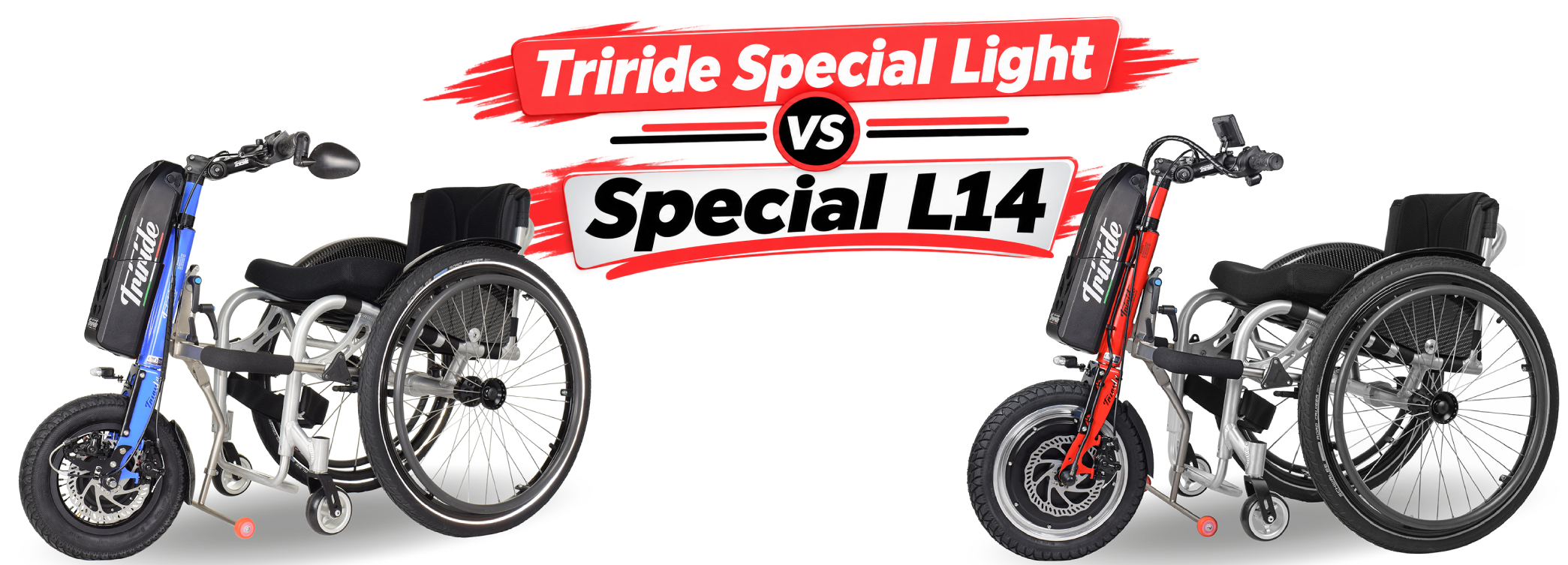
Triride Special Light vs Special L14
The Triride Special Light and Triride Special L14 are two powered front attachments designed to give manual wheelchair users additional mobility and independence. Both offer a 14-inch wheel option, advanced electronic controls and a claimed range of up to 50 km.
However, they are designed with different priorities. The Special Light places greater emphasis on keeping the attachment lightweight, while the Special L14 offers a more powerful motor configuration for demanding journeys.
So, which one should you choose?
This comparison examines their confirmed specifications, practical differences and the factors worth considering before making your decision.
Want to Try These Products for Yourself?
See how these wheelchair power attachments work for you. Visit our next Roadshow or arrange a personal demonstration.
Try These Products at Our Next Roadshow
Meet the team, explore the products and try them in person at our next Wheelchair Roadshow UK event.
Next Roadshow: 10 April (date to be confirmed)
Register for the Roadshow →Prefer to Try One Now?
Arrange a free home, showroom or online demonstration with Invictus Active at a time that suits you.
No need to wait for the next Roadshow.
Book Your Free Demo →Triride Special Light vs Special L14: Quick Comparison
The table below highlights the main differences using Triride’s published technical documentation.
| Specification | Special Light | Special L14 |
|---|---|---|
| Maximum motor power | 900 W (36 V) / 1,200 W (48 V) | 1,500 W (48 V) |
| Maximum torque | 50 Nm | 50 Nm |
| Attachment weight | From 8.5 kg | From 11.9 kg |
| Wheel size | 12 or 14 inches | 14 inches |
| Battery voltage | 36 V or 48 V | 48 V |
| Maximum claimed range | Up to 50 km | Up to 50 km |
| Tyre options | City or Cross | City or Cross |
| Driving modes | Normal / Sport | Normal / Sport |
| Energy-saving mode | Eco Drive | Eco Drive |
| Reverse | Yes | Yes |
| Cruise control | Yes | Yes |
| Assisted load | Yes | Yes |
| Electronic regenerative braking | Yes | Yes |
| Disc brake | Yes | Yes |
| Display | LCD | LCD |
The most noticeable difference is weight. The Special Light starts at 8.5 kg, compared with 11.9 kg for the Special L14.
That is a difference of approximately 3.4 kg before accounting for the battery and mounting arms.
The L14 has a higher published maximum motor power rating, although both models are listed with the same maximum torque.
1. Triride Special Light: Lightweight Performance and Versatility
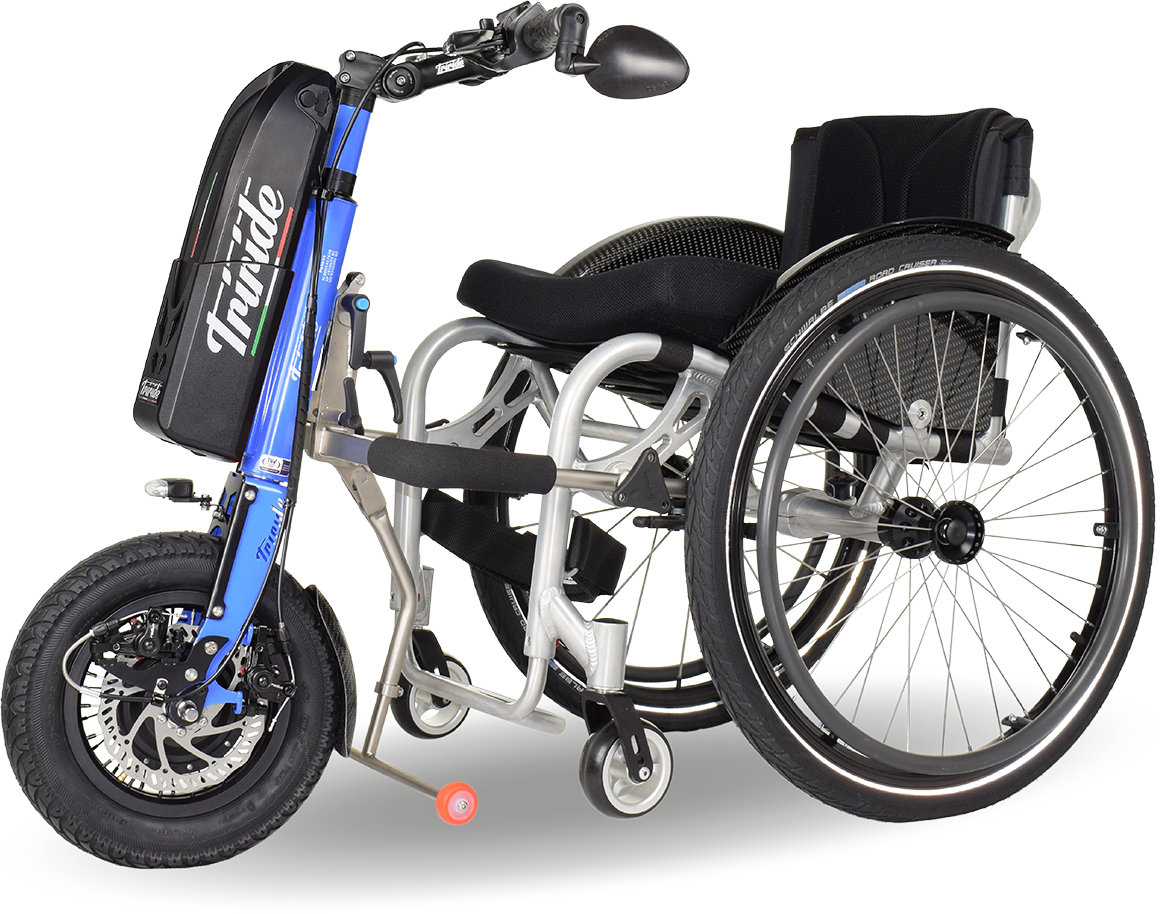
The Triride Special Light is designed for wheelchair users who want a capable powered attachment without adding as much weight as some larger models.
Its compact design combines a stainless-steel frame, aluminium wheel rim and Triride electronic control system.
One of its main attractions is its lower attachment weight, starting at 8.5 kg, excluding the battery and wheelchair connection arms.
Motor power and performance
⇒ 900 W maximum power with a 36 V configuration.
⇒ 1,200 W maximum power with a 48 V configuration.
⇒ Maximum torque of 50 Nm.
The available power configuration depends on the selected battery and model specification.
The 50 Nm torque rating provides useful information about the motor’s rotational force. However, it should not be considered a complete measure of climbing ability.
Actual performance also depends on the rider’s weight, wheelchair setup, battery, terrain and electronic configuration
Wheel and battery options
It also supports 36 V and 48 V lithium-ion battery configurations.
This gives buyers more flexibility when discussing their requirements with a Triride dealer.
City and Cross tyre options are available. These allow the attachment to be configured for different surfaces and intended uses.
Driving features
⇒ Normal and Sport driving modes.
⇒ Eco Drive energy-saving mode.
⇒ Reverse function.
⇒ Reverse function.
⇒ Cruise control.
⇒ Electronic regenerative braking.
⇒ Mechanical disc brake.
⇒ Five selectable power levels.
⇒ LCD display.
The regenerative braking system can recover some energy during braking, helping to improve battery efficiency.
Actual performance also depends on the rider’s weight, wheelchair setup, battery, terrain and electronic configuration
Who might prefer the Special Light?
The Special Light may be worth considering if:
⇒ Keeping attachment weight relatively low is important.
⇒ You regularly need to remove or transport the power attachment.
⇒ You prefer having a choice of 12-inch and 14-inch wheels.
⇒ You want the flexibility of 36 V and 48 V battery configurations.
⇒ Your everyday journeys include a mixture of indoor and outdoor environments.
Its lower weight is an important consideration for anyone who frequently transports their equipment.
However, the complete setup still needs to be assessed. Battery weight, connection arms and handling arrangements all affect the weight you actually need to manage.
2. Triride Special L14: Higher Motor Power for Demanding Journeys
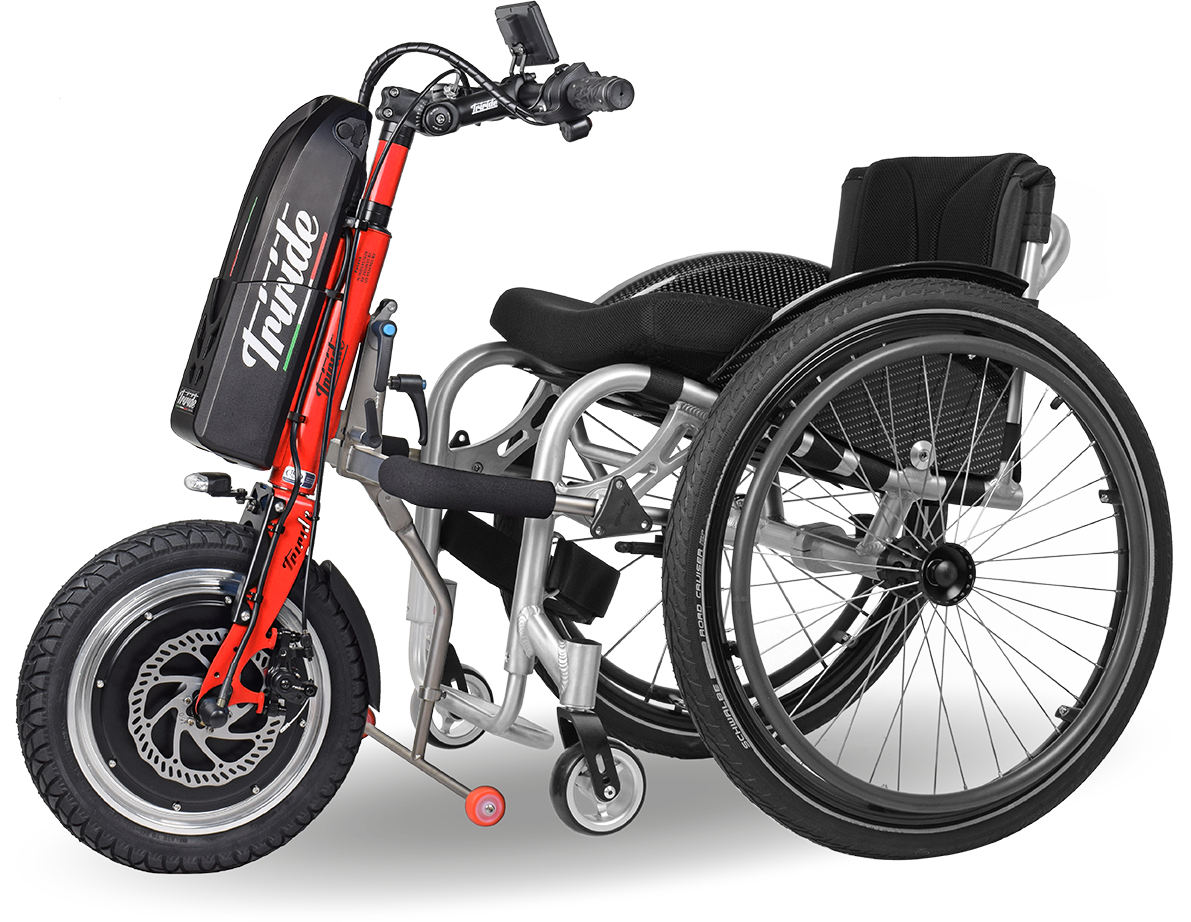
The Triride Special L14 is designed around a more powerful motor configuration and a dedicated 14-inch driving wheel.
It is aimed at wheelchair users who want additional motor power for more demanding journeys and varied outdoor conditions.
Its motor is integrated into the 14-inch wheel rim, creating a powerful front-wheel-drive attachment.
Motor power and torque
⇒ Maximum motor power: 1,500 W.
⇒ Battery voltage: 48 V.
⇒ Maximum torque: 50 Nm.
The L14’s higher maximum power rating is an important distinction from the Special Light.
However, both models have the same published maximum torque of 50 Nm.
This means the comparison should not be reduced to the assumption that the L14 has greater torque.
Motor power and torque describe different aspects of performance. The suitability of either model depends on the complete configuration and the conditions in which it will be used.
Who should consider the Triride Light?
⇒ A choice of 12-inch and 14-inch wheels.
⇒ A system with different battery configurations.
⇒ An advertised maximum range of up to 50 km.
⇒ Multiple selectable power levels.
⇒ Regenerative braking and the associated control features.
⇒ A transport configuration with a published weight from 8.5 kg.
One important detail is that Triride’s 8.5 kg figure is not the weight of every component needed for use. Its technical catalogue states that this figure excludes the battery and wheelchair connection arms. Ask the supplier for the total weight of the precise configuration you would purchase.
14-inch driving wheel
Buyers can select City or Cross tyre options, depending on the intended use and availability.
The wheel configuration, tyre choice and wheelchair setup should all be considered when assessing traction, steering and handling.
Battery and claimed range
Triride publishes a maximum range of up to 50 km.
This figure is based on controlled conditions, rather than a guaranteed distance for every rider.
The manufacturer’s technical documentation uses a 48 V 10.5 Ah battery, a flat route, an average speed of 6 km/h and a user weight of 70 kg for its stated range figure.
Actual range will vary with rider weight, terrain, battery condition, speed and driving mode.
Driving features
⇒ Normal and Sport driving modes.
⇒ Eco Drive energy-saving mode.
⇒ Reverse.
⇒ Cruise control.
⇒ Assisted load.
⇒ Electronic regenerative braking.
⇒ Mechanical disc brake.
⇒ LCD display.
⇒ Five selectable power levels.
These features provide a similar overall control package to the Special Light.
The main distinction is the L14’s higher motor power rating and heavier attachment.
Who should consider the Triride Light?
⇒ A choice of 12-inch and 14-inch wheels.
⇒ A system with different battery configurations.
⇒ An advertised maximum range of up to 50 km.
⇒ Multiple selectable power levels.
⇒ Regenerative braking and the associated control features.
⇒ A transport configuration with a published weight from 8.5 kg.
One important detail is that Triride’s 8.5 kg figure is not the weight of every component needed for use. Its technical catalogue states that this figure excludes the battery and wheelchair connection arms. Ask the supplier for the total weight of the precise configuration you would purchase.
Who might prefer the Special L14?
The L14 may be worth considering if:
⇒ You prioritise a higher motor power rating.
⇒ Your regular journeys include more demanding outdoor routes.
⇒ You want a dedicated 14-inch driving wheel.
⇒ You prefer a 48 V configuration.
⇒ The additional attachment weight is not a major concern.
It is particularly worth discussing with a specialist if your usual journeys involve sustained inclines or challenging surfaces.
A proper demonstration is important because published motor specifications cannot predict how an attachment will perform with every wheelchair and rider.
3. Weight Difference: Is the Special Light Easier to Transport?
Weight is one of the most important differences between these two models.
The Special Light starts at 8.5 kg, while the Special L14 starts at 11.9 kg.
| Model | Published attachment weight |
|---|---|
| Triride Special Light | From 8.5 kg |
| Triride Special L14 | From 11.9 kg |
| Difference | 3.4 kg |
For someone who regularly removes the attachment before travelling by car, this difference could be particularly relevant.
A lighter attachment may be easier to lift and position. However, the complete lifting weight will depend on the selected battery and accessories.
It is also worth considering where the attachment will be stored, whether assistance is available and how frequently it needs to be connected or disconnected.
If transport is a priority, ask the supplier to demonstrate the complete removal and refitting process.
4. Motor Power vs Torque: What Is the Actual Difference?
However, they do not mean the same thing.
Motor power, measured in watts (W), indicates the rate at which the motor can deliver energy.
Torque, measured in newton metres (Nm), describes the rotational force produced by the motor.
The published figures for these models are:
| Specification | Special Light (48 V) | Special L14 |
|---|---|---|
| Maximum motor power | 1,200 W | 1,500 W |
| Maximum torque | 50 Nm | 50 Nm |
However, both models share the same stated maximum torque.
This distinction matters because higher wattage alone does not guarantee better real-world performance in every situation.
Wheel size, traction, battery output, electronic settings, rider weight and road conditions all contribute to the overall experience.
If you regularly encounter steep inclines, ask for a demonstration using a configuration suitable for your wheelchair and typical journeys.
5. Battery Life and Range: Which Travels Further?
At first glance, there is no difference between these models in their advertised maximum range.
Both are listed with a range of up to 50 km.
However, this should not be interpreted as a guarantee that both will achieve the same distance in everyday use.
Special Light range
The Special Light supports 36 V and 48 V battery configurations.
Its published range figure is based on either a 36 V 14 Ah or 48 V 10.5 Ah battery.
Special L14 range
The Special L14 uses a 48 V battery configuration.
Its published range figure is based on a 48 V 10.5 Ah battery.
What affects actual battery range?
Several factors can influence how far you travel on a single charge:
⇒ Total weight of the rider and wheelchair.
⇒ Battery capacity and condition.
⇒ Uphill and downhill journeys.
⇒ Road surfaces and tyre pressure.
⇒ Selected driving mode.
⇒ Speed and acceleration.
⇒ Weather and riding conditions.
For longer journeys, ask your supplier which battery capacity is available with your chosen configuration.
It is also worth discussing charging times, replacement battery costs and the availability of spare batteries.
6. Wheel Size and Tyre Options
The Special Light offers 12-inch and 14-inch wheel configurations, whereas the Special L14 is designed around a 14-inch wheel.
Both models offer City and Cross tyre options.
The most suitable choice depends on the surfaces you regularly travel across.
A City tyre may be appropriate for predominantly urban journeys and smoother paths.
A Cross tyre may be worth considering for users who regularly encounter rougher outdoor surfaces.
However, tyre choice alone does not guarantee better traction or suitability for every terrain.
The complete wheelchair and attachment combination should be assessed before making a decision.
7. Which Model Is Better for Everyday Use?
There is no single answer because everyday mobility requirements differ considerably.
The Special Light may appeal to someone who regularly removes their attachment, transports it in a car or wants a lower-weight configuration.
The L14 may appeal to someone who places greater importance on its higher motor power rating and is comfortable managing a heavier attachment.
Consider the following situations.
Regular car travel
The Special Light’s lower published weight may make it worth investigating first.
However, check the complete lifting weight rather than relying on the attachment weight alone.
Regular outdoor journeys
The L14’s higher published motor power may make it an interesting option for more demanding journeys.
Nevertheless, a practical demonstration is the best way to establish whether the difference matters for your particular routes.
Longer journeys
Neither should automatically be considered the longer-range option.
Instead, compare the battery configurations available and ask the supplier to estimate realistic range for your weight and typical journeys.
8. Special Light vs Special L14: Advantages and Considerations
There is no single answer because everyday mobility requirements differ considerably.
The Special Light may appeal to someone who regularly removes their attachment, transports it in a car or wants a lower-weight configuration.
The L14 may appeal to someone who places greater importance on its higher motor power rating and is comfortable managing a heavier attachment.
Consider the following situations.
Triride Special Light
Potential advantages
⇒ Lower published attachment weight.
⇒ Choice of 12-inch or 14-inch wheel.
⇒ 36 V and 48 V battery configurations.
⇒ 50 Nm maximum torque.
⇒ Up to 50 km published range.
⇒ Comprehensive electronic control features.
Things to consider
⇒ Lower maximum published motor power than the L14.
⇒ Actual transport weight increases when the battery and connection arms are included.
⇒ The best wheel and battery configuration depends on individual requirements.
Triride Special L14
Potential advantages
⇒ Higher published maximum motor power of 1,500 W.
⇒ Dedicated 14-inch driving wheel.
⇒ 50 Nm maximum torque.
⇒ Up to 50 km published range.
⇒ 48 V battery configuration.
⇒ Electronic regenerative braking and assisted load.
Things to consider
⇒ Heavier published attachment weight.
⇒ No 12-inch wheel option in the standard specification.
⇒ Battery and configuration choices should be confirmed with the supplier.
⇒ Higher motor power does not guarantee better performance in every riding situation.
9. What Should You Check Before Choosing?
Before purchasing either attachment, consider more than the headline specifications.
A powered attachment needs to work properly with your existing wheelchair and your everyday mobility requirements.
Here are some useful questions to discuss with your supplier:
Wheelchair compatibility: Can the attachment be fitted safely to your exact wheelchair model?
Mounting arrangements: Which brackets and connection arms will be required?
Battery configuration: Which battery capacity is available, and what is its actual weight?
Transport: Can you comfortably remove, lift and store the complete attachment?
Driving conditions: Which configuration is suitable for your usual roads, paths and inclines?
Controls: Are the standard controls suitable, or would customised controls be beneficial?
Braking: Can you comfortably operate the braking system and understand the available electronic braking functions?
Demonstration: Can you test the attachment using your own wheelchair?
Servicing: What warranty, servicing and replacement battery support are available in the UK?
A specialist assessment can help identify compatibility issues before you commit to a purchase.
10. Triride Special Light vs Special L14: Final Verdict
Both the Triride Special Light and Special L14 offer capable powered wheelchair attachment systems.
They share several important specifications, including 50 Nm maximum torque, a claimed range of up to 50 km and a comprehensive electronic control package.
The main differences are their weight, motor power and wheel configuration.
Choose the Triride Special Light if keeping the attachment lighter is a priority. Its starting weight of 8.5 kg and choice of 12-inch or 14-inch wheels make it an interesting option for people who regularly transport or remove their equipment.
Consider the Triride Special L14 if you prioritise higher motor power. Its 1,500 W maximum power rating and dedicated 14-inch wheel make it worth investigating for more demanding journeys.
Ultimately, neither model is automatically the better choice for everyone.
The right attachment is the one that works safely with your wheelchair, suits your everyday routes and can be managed comfortably when fitted, removed and transported.
If you are unsure, arrange a demonstration before making your decision.
WHEELCHAIR ROADSHOW UK
Want to try one for yourself?
Come along to a future Wheelchair Roadshow UK event to explore wheelchair power attachments and mobility equipment in person. Prefer to speak to someone sooner? You can request a free demonstration, subject to availability.
This button will be activated once the demonstration form is available.